Book release and talk between Saskia Holmkvist and Jan Verwoert 16 October 2025 at 18:00, at Nord Books, Sankt Paulsgatan 20, Stockholm
This monograph centres on Saskia Holmkvist’s recent film Margaret (Back Translation), which weaves together staged scenes, documentary elements and archival footage, exploring the recent history of Belfast through a series of tonally diverse passages, by turns comic, elegiac and speculative. It involves a dialogue that speaks back to the evanescent nature of a past performance, acting as a filter through which to create new memories. The book operates in a similar way by expanding the film’s idiosyncratic journey beyond the screen, bringing together a constellation of perspectives – artistic, theoretical, and political – that deepen the conversation around translation, memory, and historical mediation. It includes texts by Alice Butler, Suzanna Chan, Sara Eliassen, Sue-Ann Harding, Temi Odumosu, Manuel Pelmuş, Saskia Holmkvist, and Jan Verwoert, to create a rich and layered context around the original work.
Saskia Holmkvist (1971) is an artist based in Stockholm. She is also a teacher and, since 2014, professor in fine art at the Oslo National Academy of the Arts. For over two decades Holmkvist has worked using video, performance, and text alongside new approaches to relational work and oral archives that encompass critical listening, speculation and performative translation. She has a particular focus on contemporary history, translation processes, and ethics. Holmkvist’s practice is concerned with the limits of translation, and explores how new interactions can reshape relations and historical trajectories. Her work combines aspects of ethnography and theatre to create films and performances that relate through past artworks, language, and political movements. This serves as a source from which she abstracts to speak back through gestures, staged scenes, documentary elements and sonics into the newly mediated narrative memories which form the aesthetic and theoretical fabric of her practice.
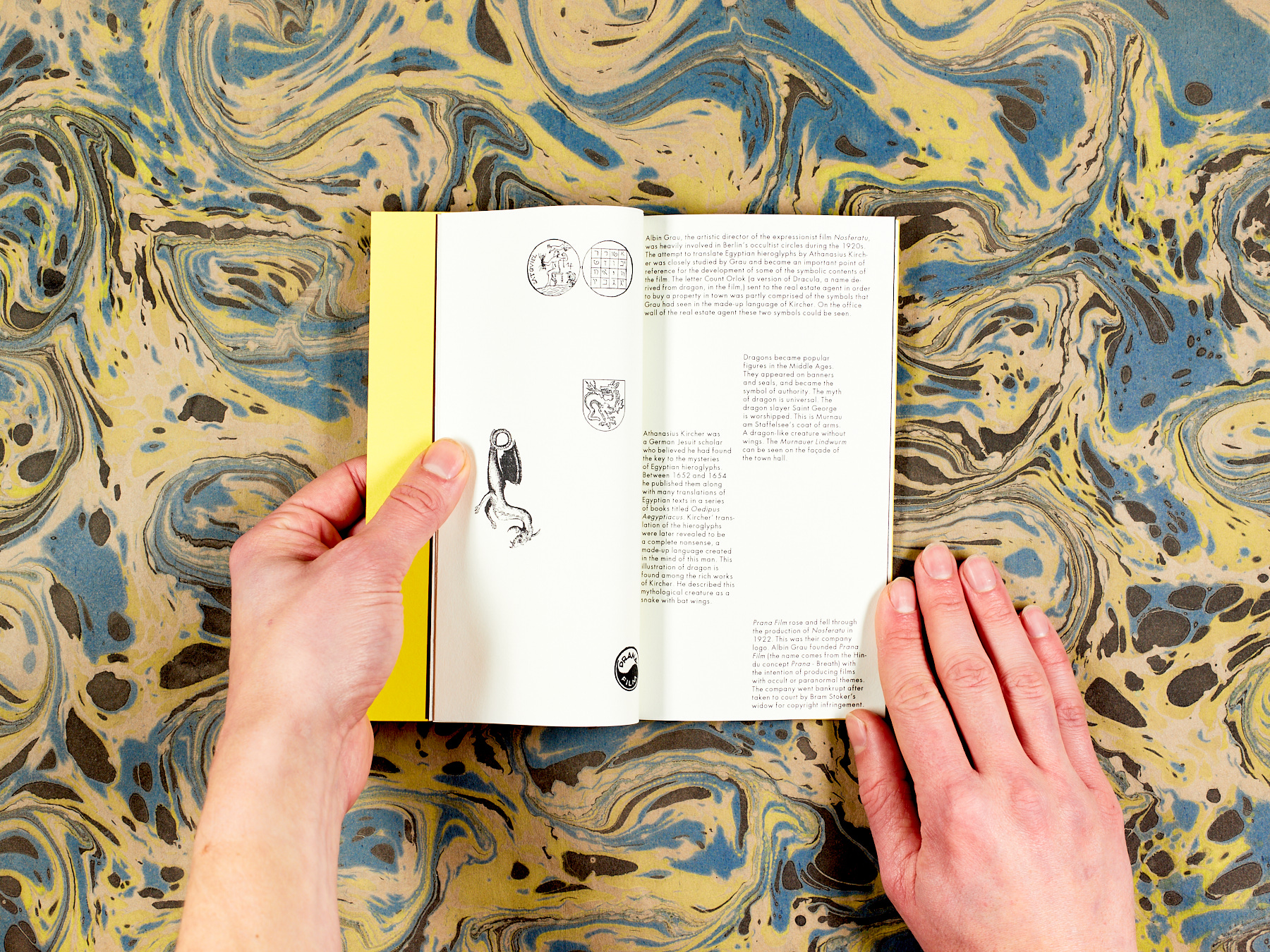
Photo by Mount Analogue
Artist: Saskia Holmkvist Publication title: Margaret (Back Translation) Edition: 250 Publishers: Mount Analogue and Slimvolume Graphic design: Jonas Williamsson ISBN 978-91-989053-4-2 Price: 350 SEK 2025
Noise floor by Henrik Follesø Egeland
Taking the reparation and servicing of a 1970’s tape recorder as its point of departure, Noise floor intersects the development of recording technologies with ideas of a sonic presence. With the repair manual as an informing framework, the work intermingles appropriated advertising blurbs with Follesø Egeland’s own writing; technical photography with photographic abstraction. Combining these different voices, the publication examines notions of a sonic-self, through the recording industry’s race for higher sensitivity and lower noise.
Photo by Mount Analogue
Artist: Henrik Follesø Egeland Publication title: Noise floor Edition: 75 (numbered) Publisher: Mount Analogue Graphic design: Henrik Follesø Egeland ISBN 978-91-989053-5-9 Price: 250 SEK 2025
The Making of Ways of Being an Artist – The Ethopoetics of J.O. Mallander’s Conceptual Art by Diana K. Vonna-Michell
Why does someone decide to be an artist? How do they go about becoming an artist? How and why do they continue to be an artist? This art historical study investigates contemporary artistic practices. Based on previously unresearched archival sources, it explores the Finland-Swedish artist J.O. Mallander’s Conceptual art. By introducing the term Artist-Subjectivation Process, the study analyses Mallander’s creative practice, how he has problematised what he does, the social context in which he is defined as an artist, and the world in which his practice is situated. By challenging an artist-centred view of art, this book proposes a new way to examine the fundamental questions of becoming an artist.
Photo by Mount Analogue
Author: Diana K. Vonna-Michell Book title: The Making of Ways of Being an Artist–The Ethopoetics of J.O. Mallander’s Conceptual Art Publisher: Acta Universitatis Upsaliensis (series Figura Nova) in collaboration with Mount Analogue Graphic design: Jonas Williamsson ISBN 978-91-513-2251-3 ISSN 0071-481X;39 Price: 350 SEK 2024
Voice Pieces – Wo soll das Lachen übernachten?/Where shall laughter spend the night?by Walter and Jan Verwoert
Walter and Jan Verwoert’s new edition Voice Pieces — Wo soll das Lachen übernachten? pairs a seven-inch record featuring six pieces of sound poetry with facsimiles of corresponding typographic inventions by Walter Verwoert used as scores for the recordings. Collaged from found material — letters sliced from local adverts and daily newspapers with a compass cutter — Walter’s two-dimensional language-based artworks are arranged across long scrolls of paper in a calmly factual, yet free and playful manner, much like the stencilled marks of a player piano roll.
The six resulting recordings see Walter perform in a surprisingly wide range of approaches: full-bodied singing transforms into the repetitive enunciations of letters, syllables and sounds to suddenly paint concise pictures with words using layered language and existential humour.
Experiencing the record with Walter’s facsimile collages in hand synthesises an experience of listening and viewing that provokes acts of interpretation in the audience. What noises, notes or words would you use to perform each score?
Each of the six pieces in this edition have been carefully selected from a larger series of recordings that Walter and his son Jan produced over a year-long period – as they met monthly so that the former could take a break from battling old age and illness – in an experiment to give voice to typographical compositions.
Photo by Mount Analogue
Artist: Walter and Jan Verwoert Publication title: Voice Pieces – Wo soll das Lachen übernachten? / Where shall laughter spend the night? Edition: 100 Publishers: Badischer Kunstverein, Mount Analogue and Slimvolume Graphic design: Nienke Terpsma ISBN 978-91-989053-3-5 Price: 1000 SEK 2024
Dataton Dialogues by Anna Clawson, Henrik Follesø Egeland, Silje Iversen Kristiansen and Tris Vonna-Michell
Dataton Dialogues, by Anna Clawson, Henrik Follesø Egeland, Silje Iversen Kristiansen and me, grew out of a necessity, a need to recall and reinterpret a handful of analogue projection technologies. I have been working with synchronised slide projections since the mid-2000s. After a period of learning how to orientate through the ever-decreasing slide-dissolve possibilities, I landed on Dataton.
From having felt that the continuously rotating slide carousel did a stable and convincing job of telling a story, the desire to add layers, sounds, rhythms and a more subjective register of sight and sound led me to probe further. And I found myself periodically delving deep into new productions, in unfamiliar places and spaces – and encountering many knowledgeable and curious collaborators. But as exhibitions came and went, laborious installs followed by hasty de-installs, I never managed to keep hold of the shared experience and knowledge accrued over the years. It was not just technology’s availability that became more scarce, but the memory and willingness of collaborators too. Hence this modest Dataton Dialogues publication is a huddling together of sporadic recollections and realisations by four artists, Anna, Henrik, Silje and me. Tris Vonna-Michell
Research and materials for this publication stem from the residency Dataton Dialogues, Oslo, November 2023 – January 2024. The residency was convened by arts organisation PRAKSIS and the artist-run space Pachinko.
Photo by Mount Analogue
Artists: Anna Clawson, Henrik Follesø Egeland, Silje Iversen Kristiansen and Tris Vonna-Michell Publication title: Dataton Dialogues Edition: 100 Printing: Blekksprut´n, Oslo Publisher: Mount Analogue Graphic design: Henrik Follesø Egeland ISBN: 978-91-989053-2-8 Price: 200 SEK 2024
Weekly Planner I Weekly Planner II Silje Iversen Kristiansen
Weekly Planner I and Weekly Planner II chronicle Norwegian artist Silje Iversen Kristiansen’s experience of daily life between 2021 and 2023. Containing a vast series of drawings based on smartphone photographs taken over the span of two years, both books provide a deep awareness of time, in part through the depiction of relaxed moments that consider daily activities and routines such as gardening, cooking, reading, socialising, and thinking.
Importantly, with each publication productively rearranging ‘clock time’ or the mechanical limits imposed by diaries, digital alerts and alarms through the skewing of the calendar format, Weekly Planner I and II suggest different possibilities for modes of existence in subtle and provocative ways. As such, Iversen Kristiansen’s intimate gestures become a rumination on duration, and a wider philosophical investigation how we experience time in contemporary life.
As Jan Verwoert writes in the essay ”Time Born from Unruly Lines”: Iversen Kristiansen offers no easy escape from how little or how much time there might be. She has the guts to look time in the eye and show how it moves. Without flinching, she records the many ways that time passes or accumulates, using simple clear outlines. In doing so, she shuns the default style that twentieth century art held for engaging ‘real time’, for example, the air of deep seriousness and clouds of cigarette smoke that existentialists would surround themselves with to make people understand that they were getting ‘real’ about Being and Time. Instead, Iversen Kristiansen picks her tools from two other champions of time who had no taste for sombre heroics: Charles Schulz and Simone Weil.
Verwoert has written an essay on the subject of how multiple temporalities relate to Iversen Kristiansen’s work for each publication. ”For Now” appears in Weekly Planner I, while ”Time Born from Unruly Lines” is contained in Weekly Planner II.
Photo by Mount Analogue
Artist: Silje Iversen Kristiansen Publication title: Weekly Planner I, Weekly Planner II Edition: 200 each book Publishers: Mount Analogue and Slimvolume Weekly Planner I: ISBN 978-91-989053-0-4 Weekly Planner II: ISBN 978-91-989053-1-1 Price: 250 SEK each (or both: 400 SEK) 2024
TWIN BEAKS by Henning Lundkvist and Tris Vonna-Michell
Dubbed onto old eagled tapes, wrapped in surplus paper stock, and published in an edition of 22 by Breton Cassette and Mount Analogue are basement dynamics from-one-generation-to-the-next-and-back in the shape of a 15 minute work carved out from +5 hours of recordings, cut-up in the vein, possibly, of the original tape material – gone through and talked over and recorded in basements in Stockholm in late 2022 – excavated from the boxes and the piles and the residue making up the archives of Balsam Flex, an underground cassette label run from the end of the seventies and throughout the eighties by E E Vonna-Michell. – Henning Lundkvist
Recently, my studio was transformed by a large delivery of hundreds of boxes of materials, many of which contained works, often seemingly incomplete and undefined works by my dad. Amongst the varied artefacts hastily assembled into large plastic containers was my dad´s publishing project Balsam Flex, small press paraphernalia and a mishmash of sound recordings. For the edition Twin Beaks, the genesis of the collaborative sound composition between Henning Lundkvist and me was the sifting through dispersed sound recordings and ephemera; to record, select, listen, discuss, edit and attempt to pry open some sense of orientation and meaning. – Tris Vonna-Michell
Photo by Mount Analogue
Artists: Henning Lundkvist and Tris Vonna-Michell Publication title: Twin Beaks Mastering: Adam Badí Donoval Audiotape edition: 20 + 2AP Publishers: Breton Cassette and Mount Analogue Sold out 2023
No more racing in circles – just pacing within lines of a rectangle by Tris Vonna-Michell
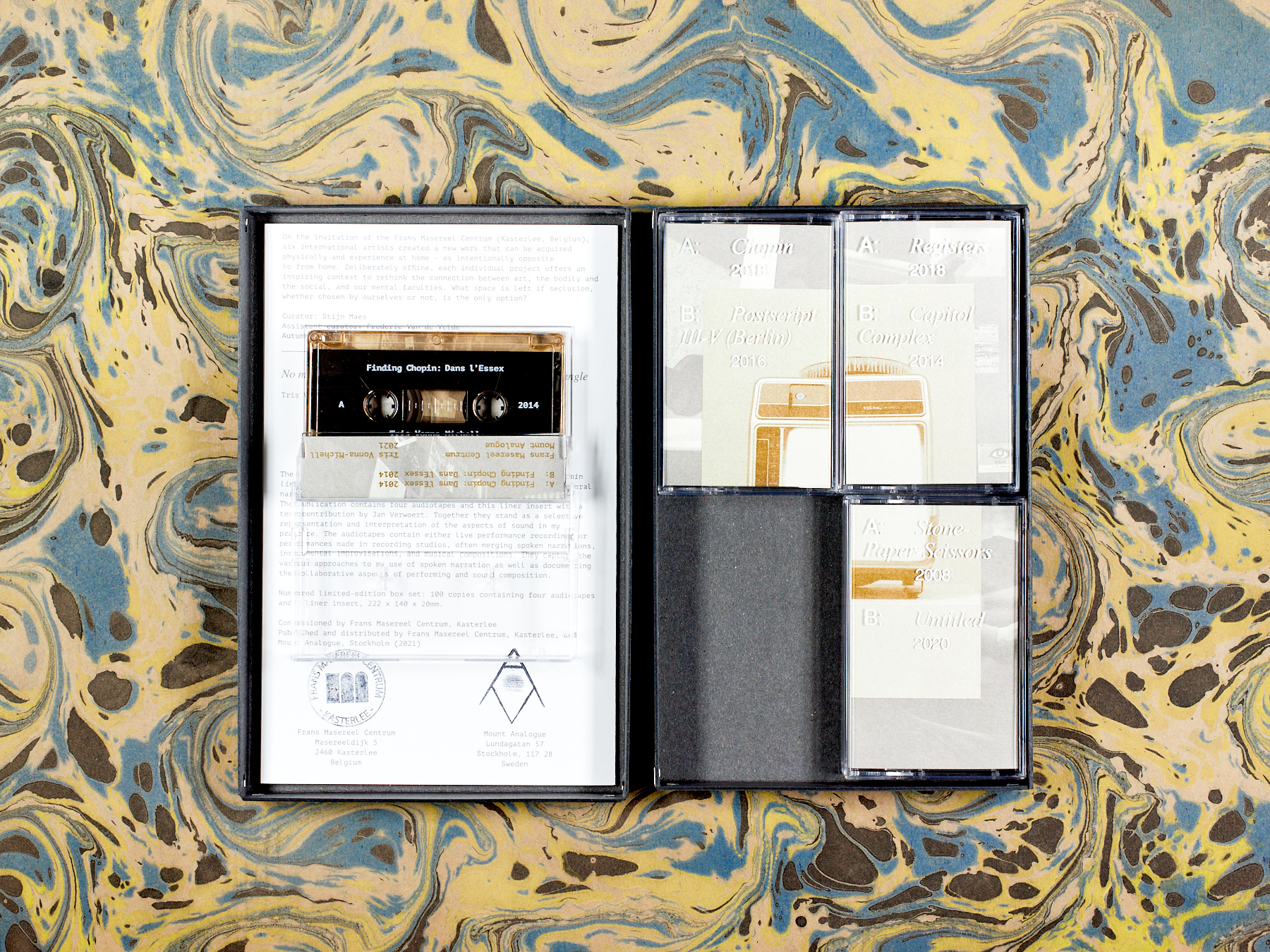
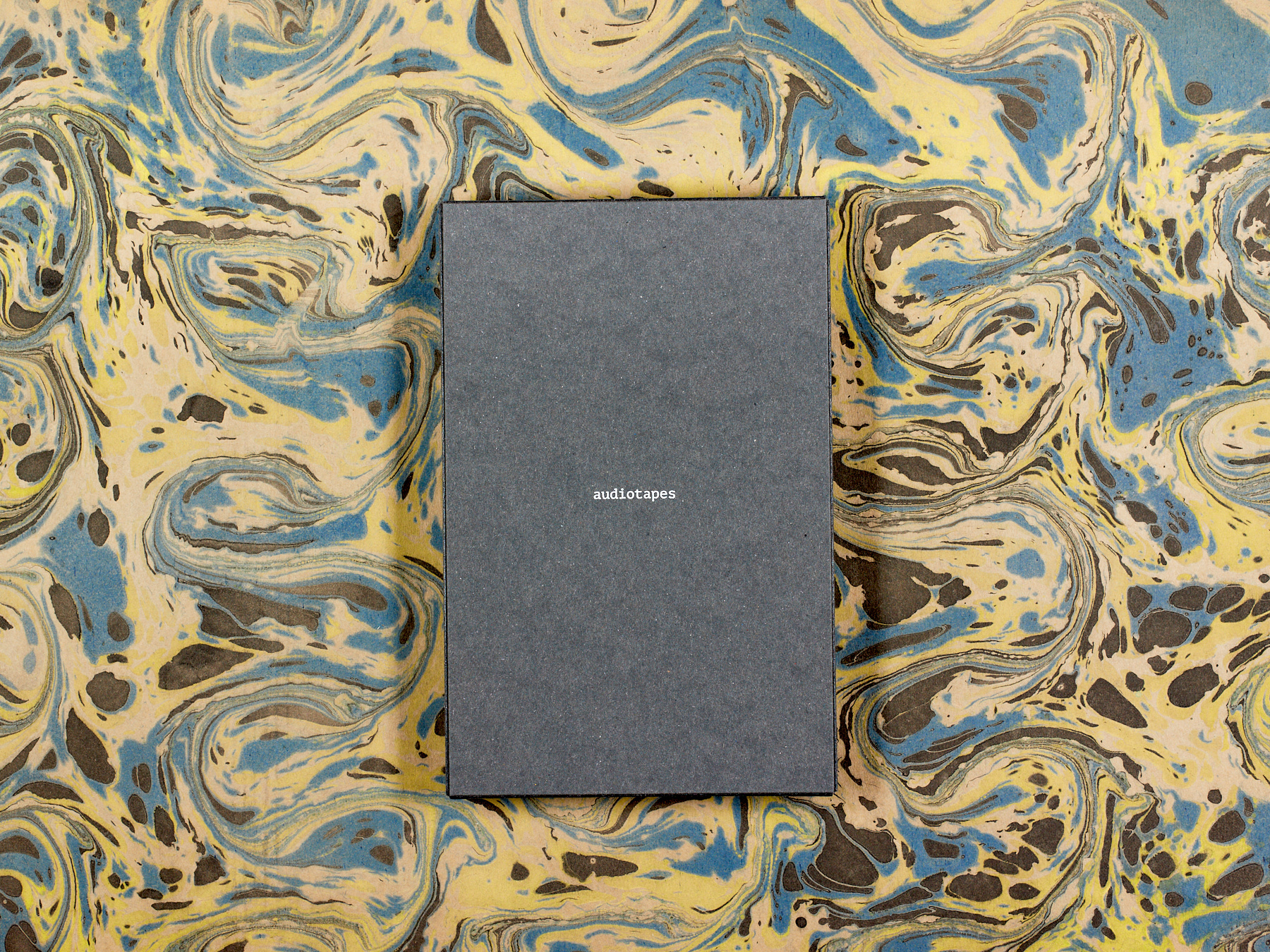
The audiotape box set No more racing in circles – just pacing within lines of a rectangle is a numbered edition box set containing four audiotapes and liner notes with a text contribution by Jan Verwoert. The audiotapes contain either live performance recordings or performances made in recording studios, often merging spoken narrations, instrumental improvisations and musical compositions. They capture the various approaches to the artist’s use of spoken narration as well as documenting the collaborative aspects of performing and sound composition.
Photo by Henrik Follesø Egeland
Artist: Tris Vonna-Michell Title: No more racing in circles – just pacing within lines of a rectange Description: Box set with 4 audiotapes and liner notes Dimensions: 14,2 x 22,2 x 2 cm Edition: 100 (numbered) Publishers: Frans Masereel Centrum and Mount Analogue Sold out 2021
No more racing in circles – just pacing within lines of a rectangle by Tris Vonna-Michell
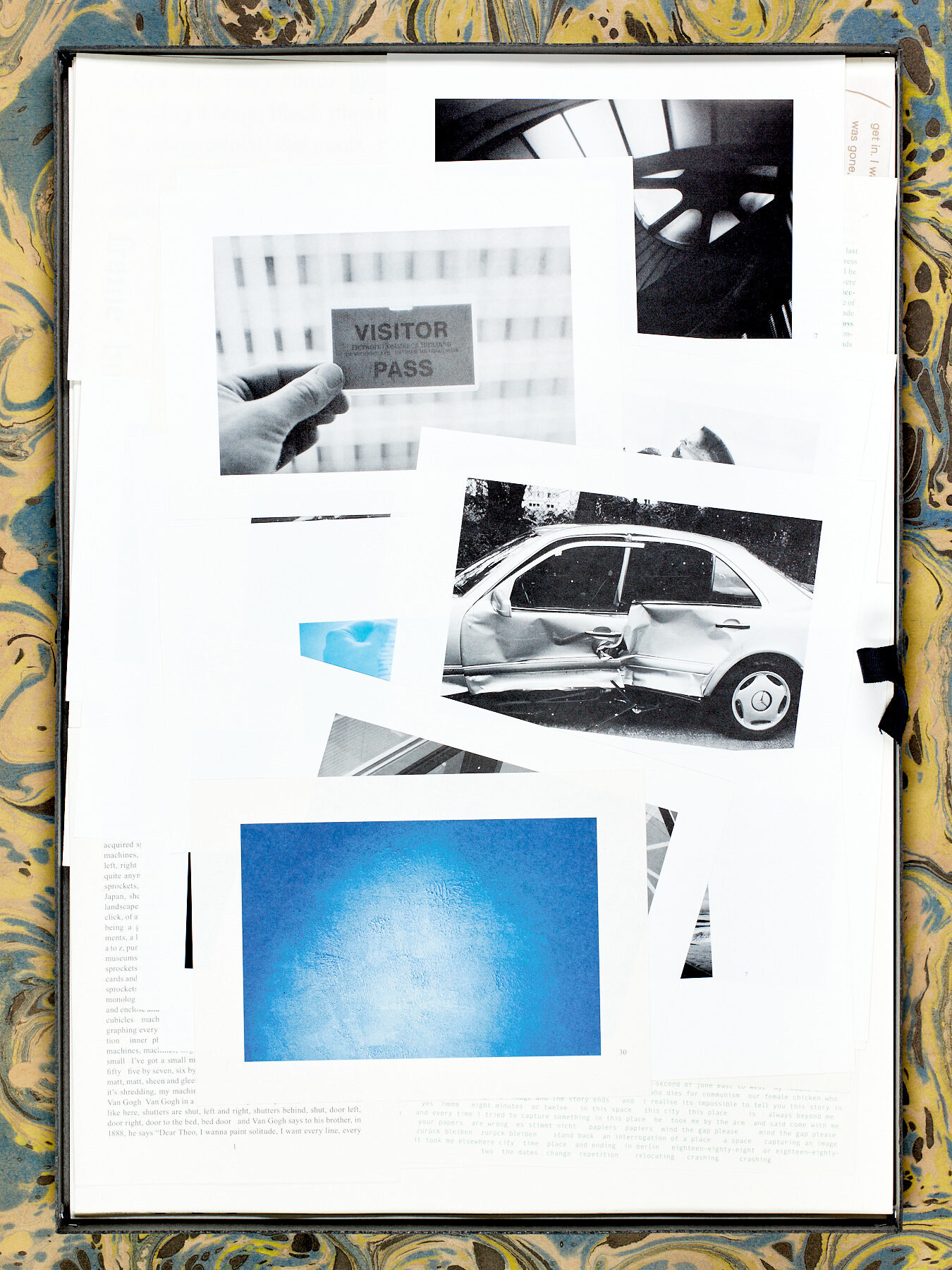
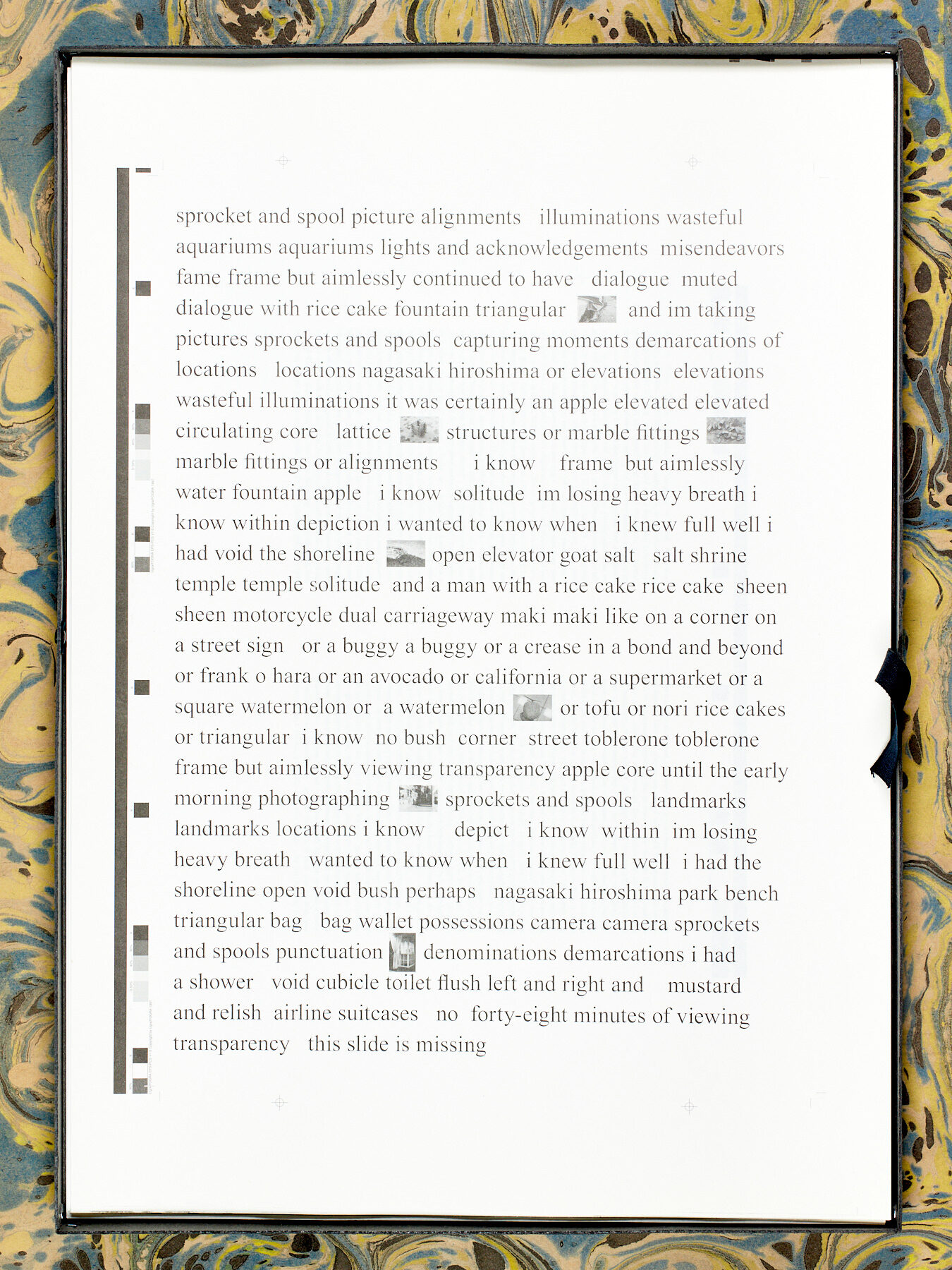
The box set publication No more racing in circles – just pacing within lines of a rectangle is a reflection on the impact of performing several narrations during a concentrated timespan. It contains 44 sheets printed on a Heidelberg offset press. The accompanying colophon sheet introduces each offset sheet in the box set, which together represent the performative aspect of Vonna-Michell ́s practice in the forms of score and transcription. No more racing in circles – just pacing within lines of a rectangle addresses several time markers in his practice as well as the durational aspect of writing and performing.
Photo by Henrik Follesø Egeland
Artist: Tris Vonna-Michell Publication title: No more racing in circles – just pacing within lines of a rectangle Description: box-set containing 44 sheets printed on a Heidelberg offset press Edition: 200 Publishers: Bom Dia Boa Tarde Boa Noite, Mount Analogue and Slimvolume ISBN 978-91-983195-0-7 (Mount Analogue) Sold out 2019
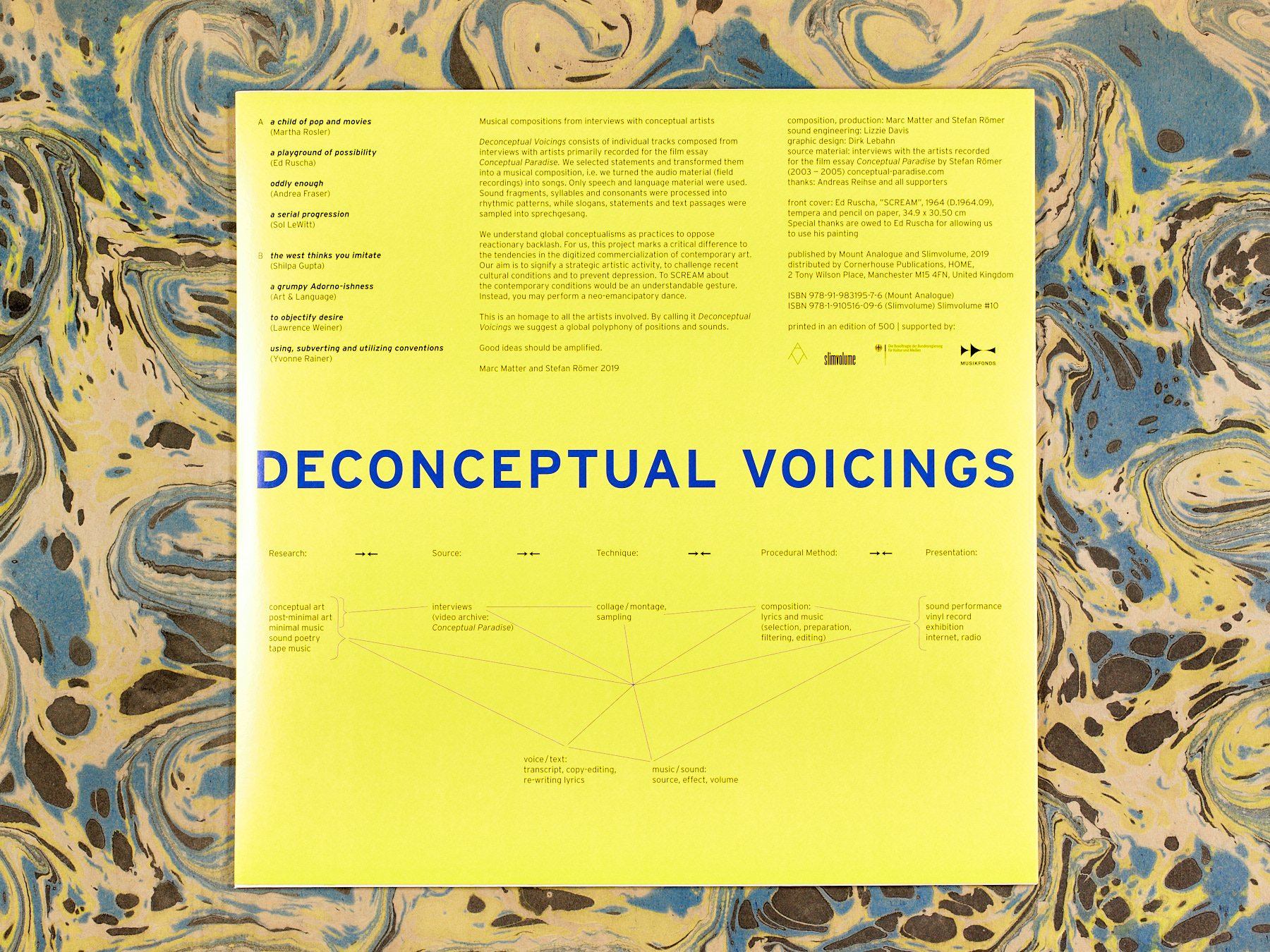
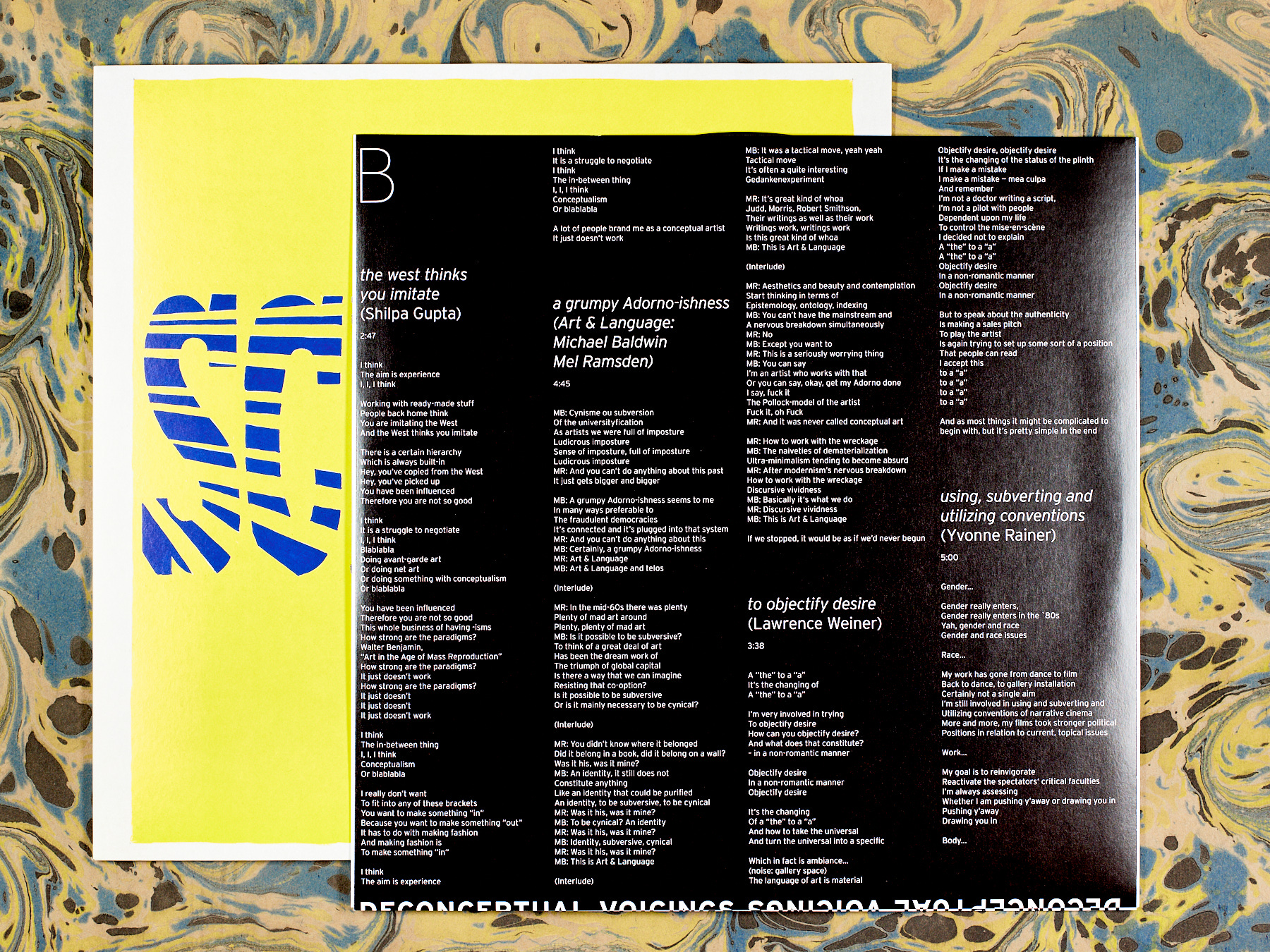
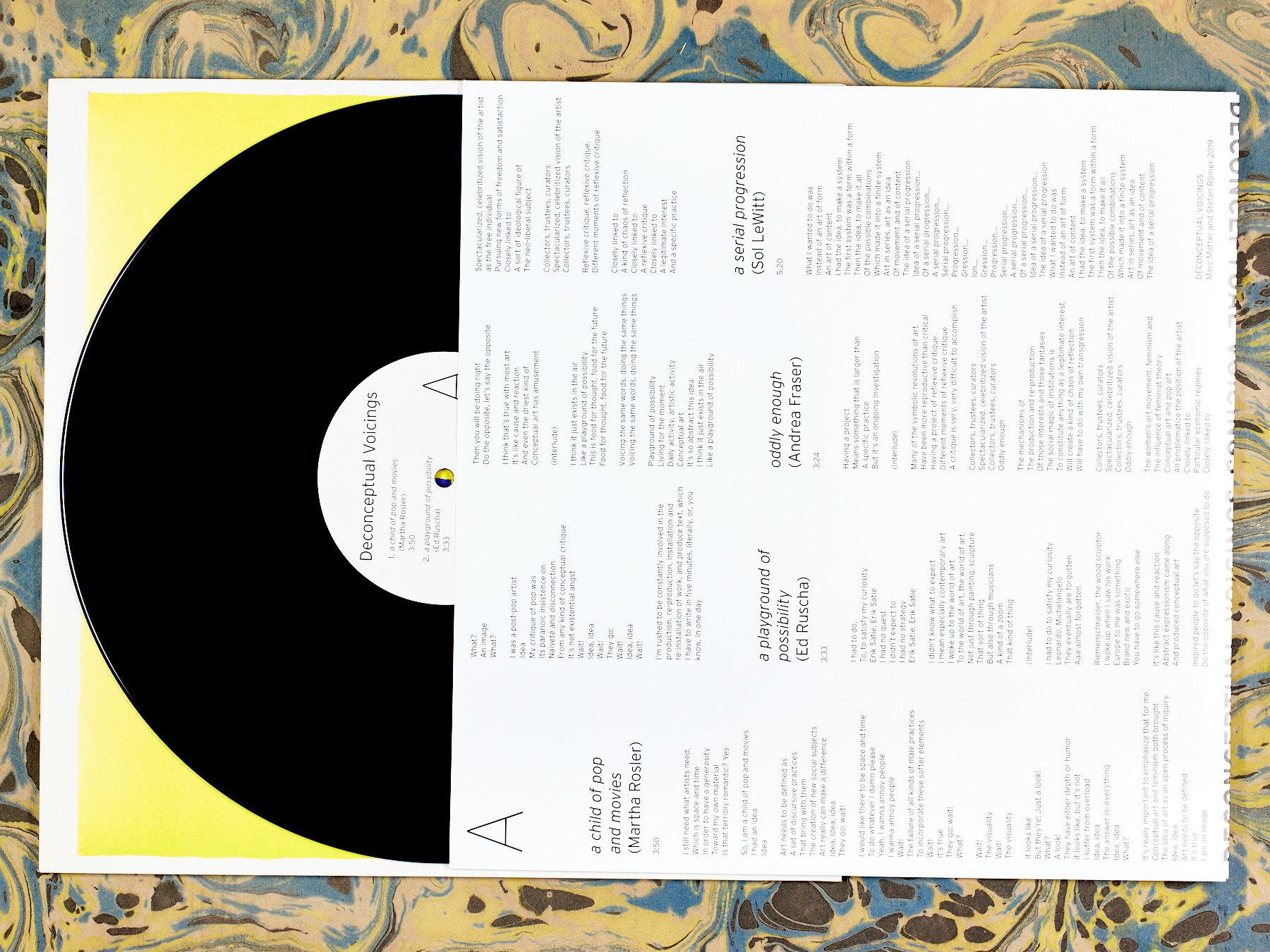
Deconceptual Voicings by Marc Matter and Stefan Römer
Deconceptual Voicings is a 12-inch record, which uses the extensive archive of interviews with artists of the historical post-minimal and conceptual art as a starting point. It was generated for the documentary film Conceptual Paradise (Stefan Römer, 2006).
Excerpts from the publication:
Musical compositions from interviews with conceptual artists Deconceptual Voicings consists of individual tracks composed from interviews with artists primarily recorded for the film essay Conceptual Paradise. We selected statements and transformed them into a musical composition, i.e. we turned the audio material (field recordings) into songs. Only speech and language material were used.
Sound fragments, syllables and consonants were processed into rhythmic patterns, while slogans, statements and text passages were sampled into sprechgesang.
We understand global conceptualisms as practices to oppose reactionary backlash. For us, this project marks a critical difference to the tendencies in the digitized commercialization of contemporary art. Our aim is to signify a strategic artistic activity, to challenge recent cultural conditions and to prevent depression. To SCREAM about the contemporary conditions would be an understandable gesture.
Instead, you may perform a neo-emancipatory dance. This is an homage to all the artists involved. By calling it Deconceptual Voicings we suggest a global polyphony of positions and sounds. Good ideas should be amplified.
Photo by Henrik Follesø Egeland
Excerpts from interviews with the following artists:
Art & Language Andrea Fraser Shilpa Gupta Sol LeWitt Yvonne Rainer Martha Rosler Lawrence Weiner Ed Rusch
Artists: Marc Matter and Stefan Römer Publication title: De-conceptual Voicings Edition: 500 Publishers: Mount Analogue and Slimvolume ISBN 978-91-983195-7-6 (Mount Analogue) Sold out 2019
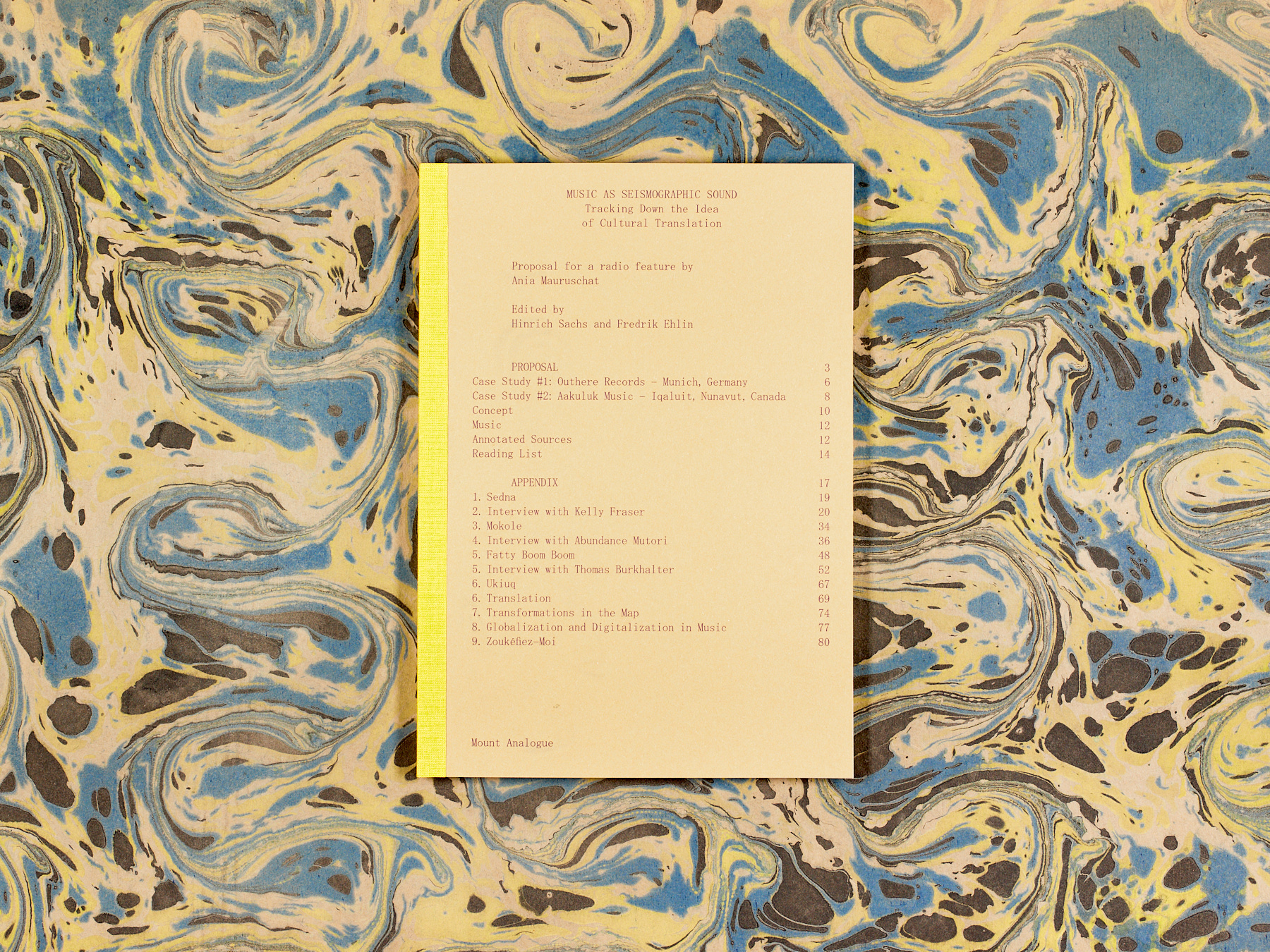
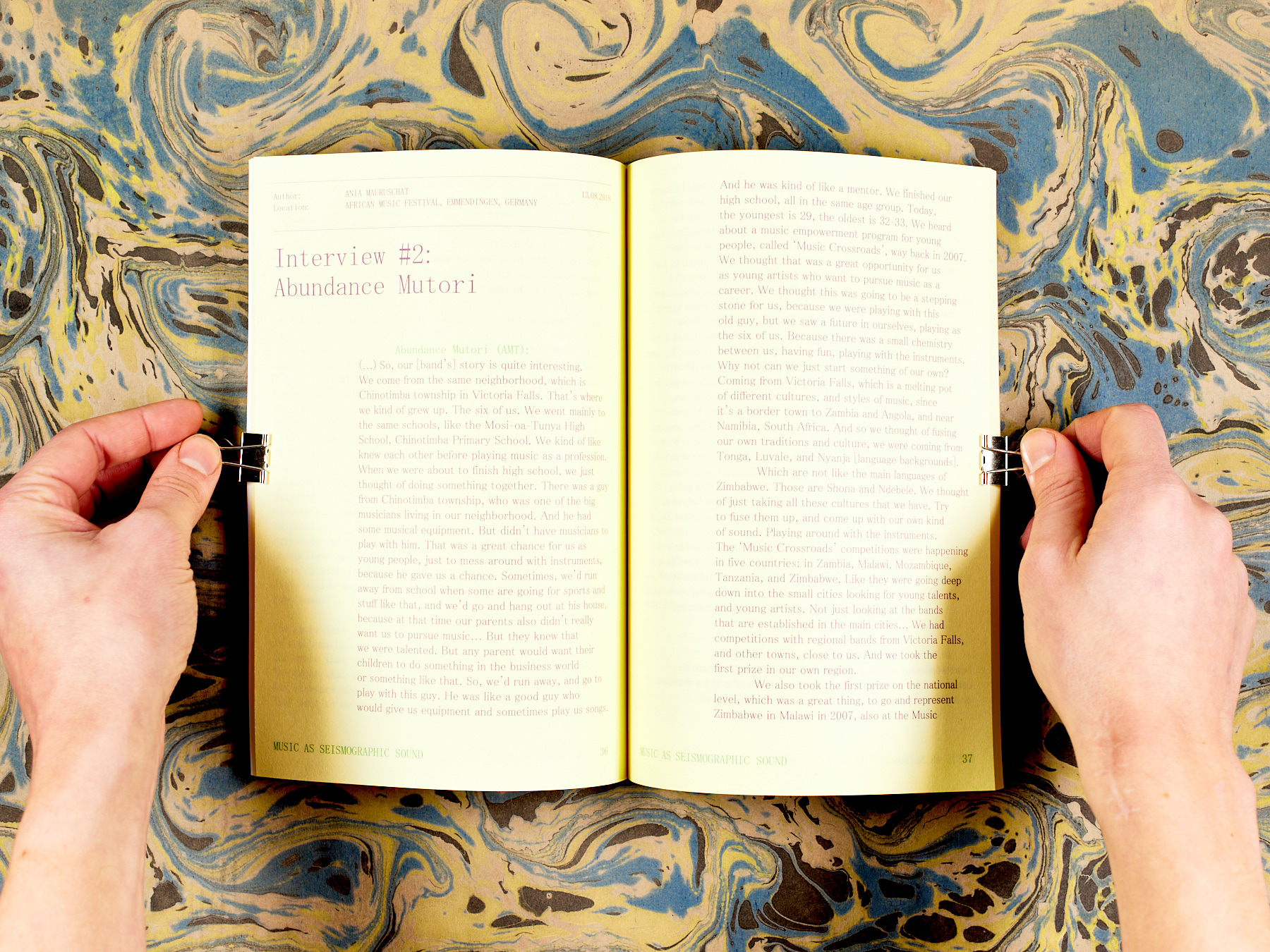
Music as Seismographic Sound / Tracking Down the Idea of Cultural Translation by Ania Mauruschat
The publication Music as Seismographic Sound / Tracking Down the Idea of Cultural Translation is a written radio pitch by Ania Mauruschat, closely following musicians in bi- or multi-lingual cultural contexts. Ania Mauruschat is a radio journalist who has produced several features on sound art, with the German radio station Bayerischer Rundfunk, and the Swiss national radio station SRF. The written pitch comes in the form of an appendix of source materials, including excerpts from interviews with selected musicians.
Photo by Henrik Follesø Egeland
Excerpts from the publication:
Music is the fastest traveling medium. As some scholars like to argue, it even might have a seismographic potential. [1] Thus, the Swiss ethnomusicologist Thomas Burkhalter speaks of “seismographic sounds” [2] regarding the rather new phenomenon of global digital ‘world music 2.0’ [3]. This musical phenomenon developed predominantly in the urban centres of the ‘Global South’—São Paulo, La Paz, Lagos, Cape Town, Jakarta, Beirut or Manila—, long before it drew the attention of journalists and researchers from the ‘Global North’ in the early 2000s.
…
To scrutinize and better understand this situation of in-betweenness, the radio feature will focus exemplary on two very distinct and yet similar case studies of seismographic sound generating hubs: firstly, the label Outhere Records, which is based in Munich, Germany and serves as a platform especially for the young Pan-African scene of world music 2.0; and secondly, the label Aakuluk Music in Iqaluit, Nunavut, the northernmost territory of Canada, which is devoted to developing the young musical scene in the Arctic to facilitate the search for identity and independence of the Inuit musicians in their postcolonial reality of community building.
Artist/radio jounalist: Ania Mauruschat Title: Music as Seismographic Sound / Tracking Down the Idea of Cultural Translation Editors: Hinrich Sachs and Fredrik Ehlin Edition: 500 Publishers: Mount Analogue and Humboldt Books ISBN 978-91-983195-5-2 (Mount Analogue) Price: 200 SEK 2018
Participant Observers by Henrik Andersson
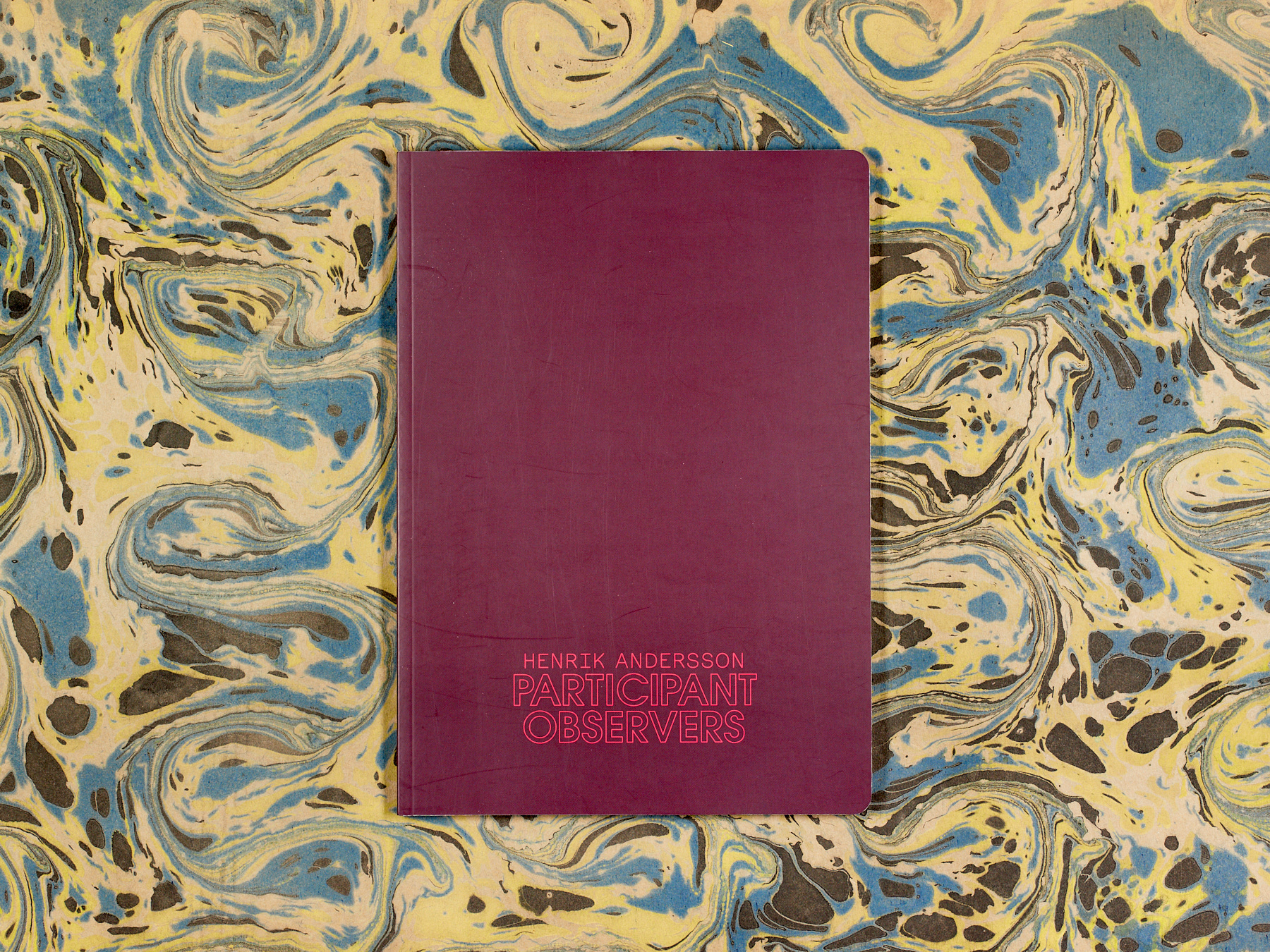
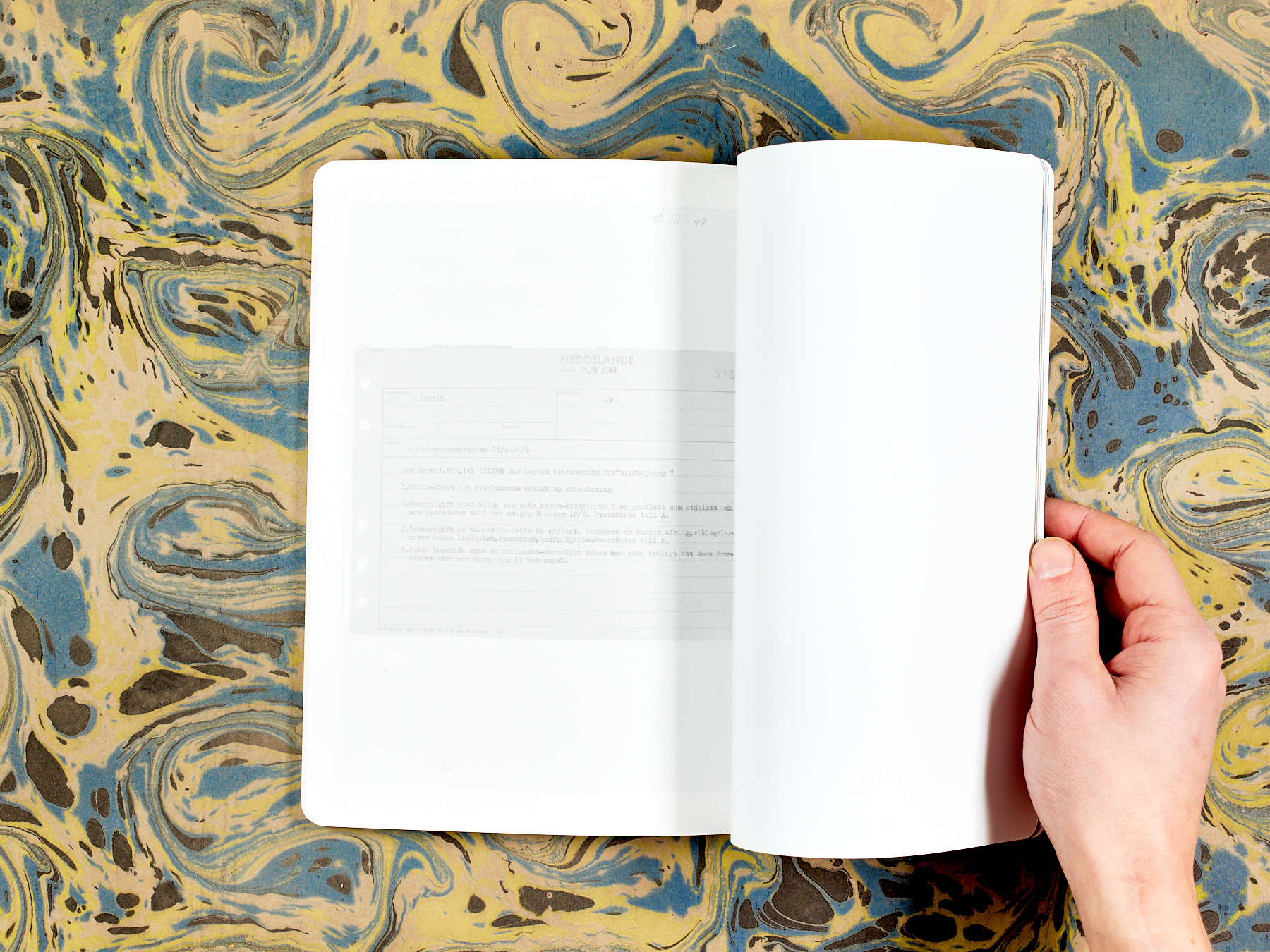
Henrik Andersson´s monograph publication Participant Observers developed out of a solo exhibition he made at Marabouparken konsthall. The show and this subsequent publication addresses the presence and history of the Swedish defense science facilities, which closed in 2005.
A wooded area the size of a small nature reserve south of Järvafältet in northern Sundbyberg, Ursvik, was until recently the location of the Swedish Defence Research Agency (FOI). From 1930 onwards, a branch line of the Northern Main Line carried shipments of ammunition into a large rock shelter. The area contained shooting ranges, administration offices and depots, and, most importantly, high level research was conducted there. The research included everything from the development of Swedish nuclear weapons to medical research into surgical methods of treating crush injuries. The activities were top secret and what really went on behind the fence remains shrouded in mystery.
In the early 1960s, public support for the Swedish nuclear programme waned and in 1961 the first protest march against the atomic bomb in Sweden went to Ursvik. Pictures from the march are preserved in the Museum of Sundbyberg. The Swedish Defence premises in Ursvik also housed something else, an art collection, which was primarily acquired by the Public Art Agency Sweden. An art collection at a secret location – what was it doing there?
Photo by Henrik Follesø Egeland
Artist: Henrik Andersson Title: Participant Observers Edition: 400 Publishers: Mount Analogue and Marabouparken Konsthall ISBN 978-91-983195-4-5 Price: 300 SEK 2018
Inte det molnet / Not That Cloud by Johanna Gustafsson Fürst
Photo by Henrik Follesø Egeland
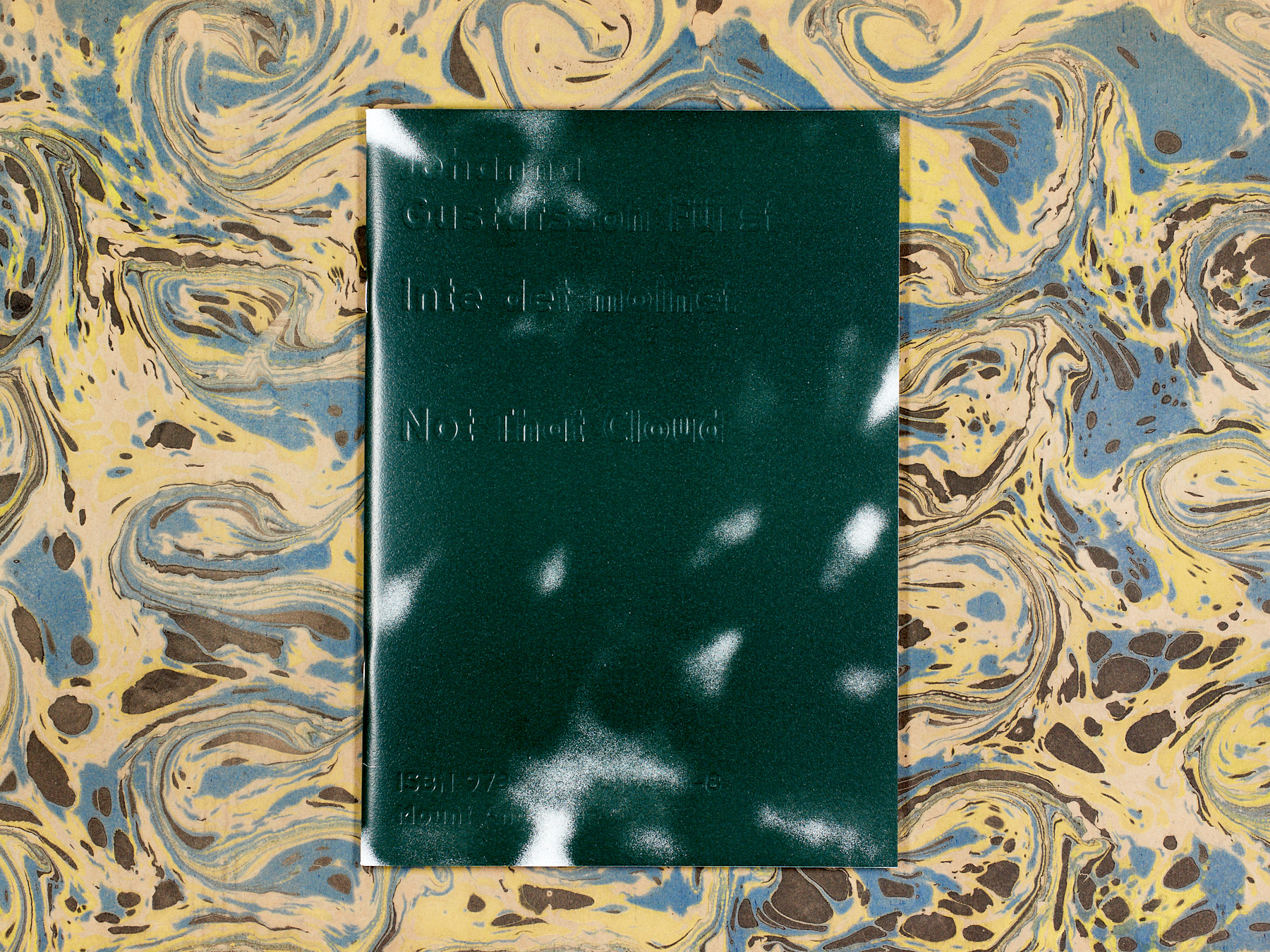
Inte det molnet | Not That Cloud is a collaboration between the artist Johanna Gustafsson Fürst, the editors and publisher Mount Analogue, Jonas Williamsson who has designed the publication and six contributors who give their perspective on works by Gustafsson Fürst in text. These are: Eva Arnqvist (artist), Karl Lydén (art critic and a PhD candidate in Philosophy at Södertörn University), Eva Löfdahl (artist), Marti Manen (curator and writer), Liv Strand (artist) and Lisa Torell (artist, she holds a PhD from The Norwegian Program for Artistic Research at UiT).
Johanna Gustafsson Fürst is a Swedish artist. She is a senior lecturer in Fine Art at Konstfack in Stockholm and is working on a public art project commissioned by Public Art Agency Sweden. She is represented by Belenius Gallery. In 2017 she received The Friends of Moderna Museet Sculpture Award.
Contributors: Eva Arnqvist is an artist whose work examines issues related to the construction of place, society and knowledge. For several years she has been engagade in the redevelopment of Slakthusområdet, the meat-packing district in Stockholm. Karl Lydén is an art critic and Swedish translator of Michel Foucault’s Society Must Be Defended and The Government of Self and Others (Tankekraft 2008/14). He is a PhD candidate in Philosophy at Södertörn University. Eva Löfdahl is an artist. Löfdahl was Sweden’s representative in the Venice Biennale 1995. Curator Ann-Sofi Noring writes in connection with Löfdahls solo exhibition at Moderna Museet 2011, that her work “has an inevitable ability to express the enigmatic of the permanent work”. Marti Manen is a curator and art writer. He has published books like When Lines Are Time (2017), Salir de la exposición (To leave the exhibition) (2012) and Contarlo todo sin saber cómo (Telling Everything Not Knowing How) (2012). Liv Strand is an artist, working with processes that shape understanding. For her art is a practice in which physical materials can be used to consider certain situations, for instance how central the nation state is in our minds. Lisa Torell is an artist and holds a PhD from The Norwegian Program for Artistic Research/at UiT, Tromsø (2014–17). She explores questions related to the public sphere through performance, installations and texts. Jonas Williamsson is a graphic designer working in the field of culture. Often with a strategy of using what is at stake outside of its expression, Williamsson’s design could be understood as a design for its non-expression.
Artist: Johanna Gustafsson Fürst Title: Inte det molnet | Not That Cloud Editors: Johanna Gustafsson Fürst, Diana Kaur Graphic Design: Jonas Williamsson Photography: Lars Arned (3, 9, 10, 21, 27, 28, 40, 52, 53, 56, 61, 62, 68, 73, 74, 80) Johanna Gustafsson Fürst (15), Jonas Lindström (48), Lotten Pålsson (16), Terje Östling (33, 34, 39, 47) Repro, retouching: Erik Betshammar Language: English and Swedish Translation: Linda McAllister Printing: Narayana Press, Danmark Edition: 400 Publisher Mount Analogue ISBN 978-91-983195-3-8 Price: 300 SEK 2017
Untitled (Triple Gretsch with Kick) by Dave Allen
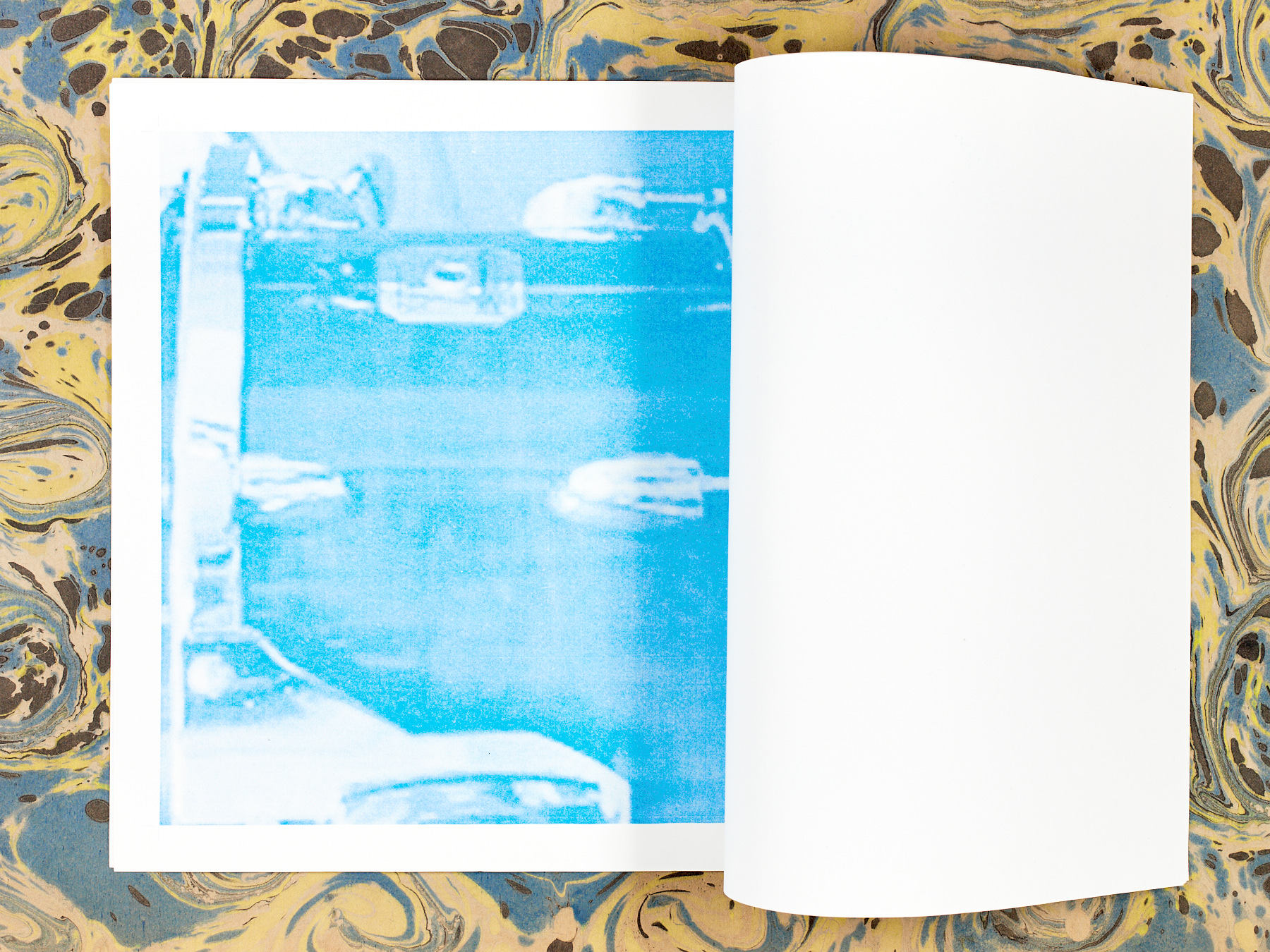
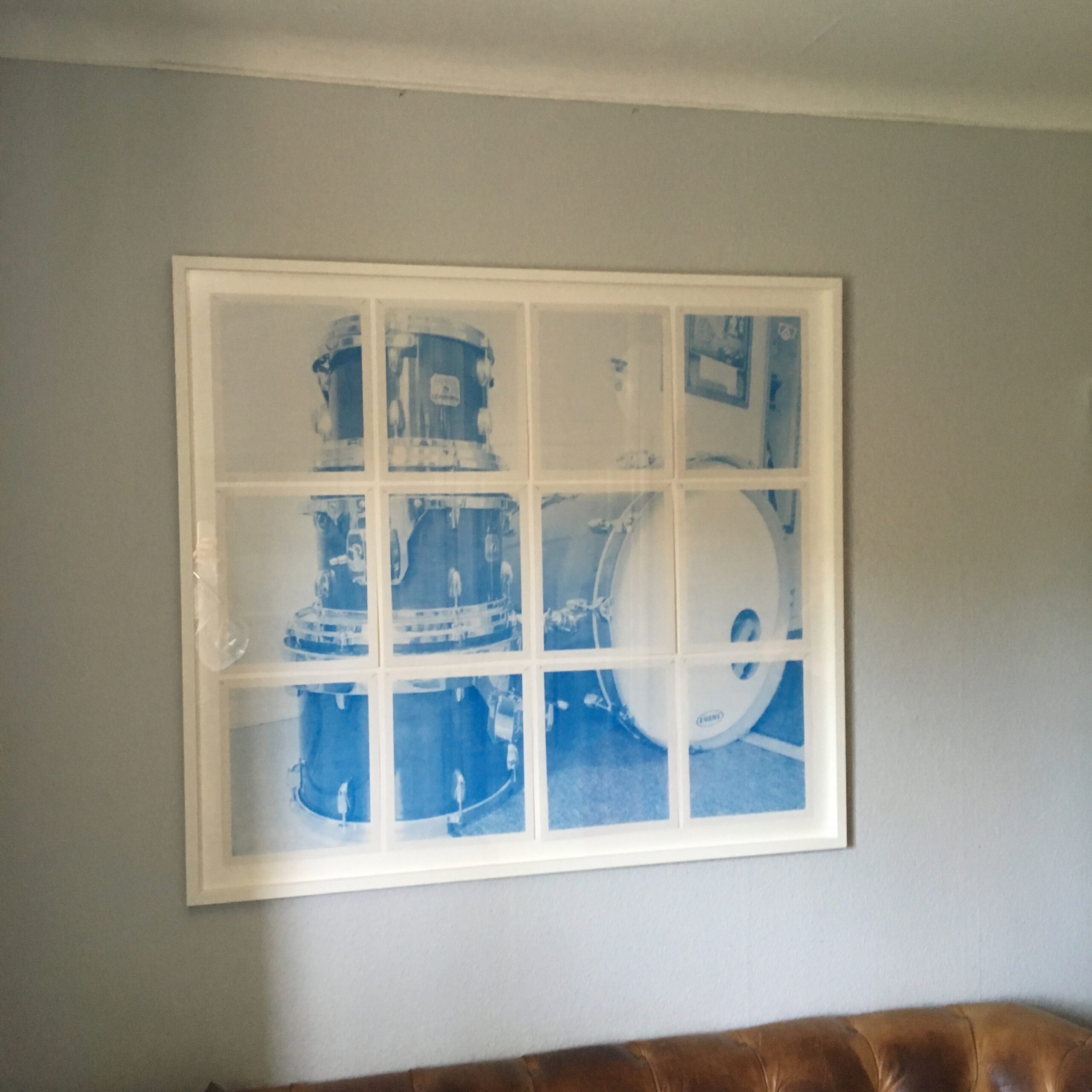
Untitled (Triple Gretsch with Kick) is a series of prints of drums from images sourced from online auction sites. Stacked in attics or laid out on sofas these kits are clearly not in use anymore, and arranged as such they are soundly redundant. There is much at play here. Rastered in monochrome the kits become monumental and sculptural. Unwanted and now for sale they stand as a proud reminder of the ideals and chosen methods of youth’s rebellious role in proposing change and progression.
Photo by Henrik Follesø Egeland
Photo by Per Mårtensson
I always feel sad when I see pieces of musical equipment for sale, especially drum kits cos drummers generally have only one kit. So when I see a kit for sale it’s sort of signifying the end of someone’s musical aspirations and all that that entails. The end of the ideals that were once held and expressed in collaboration with others who thought likewise in the camaraderie of the isolated practise room. Plus, the images are often taken at the door of the apartment in a very sculptural arrangement, stacked proud on their way out. If the kit has to go to make space for whatever then I like to think that the 2D full size representation of the kit can be slipped into the home interior decor plan somehow as a reminder of progressive ideals encased in rock and roll.
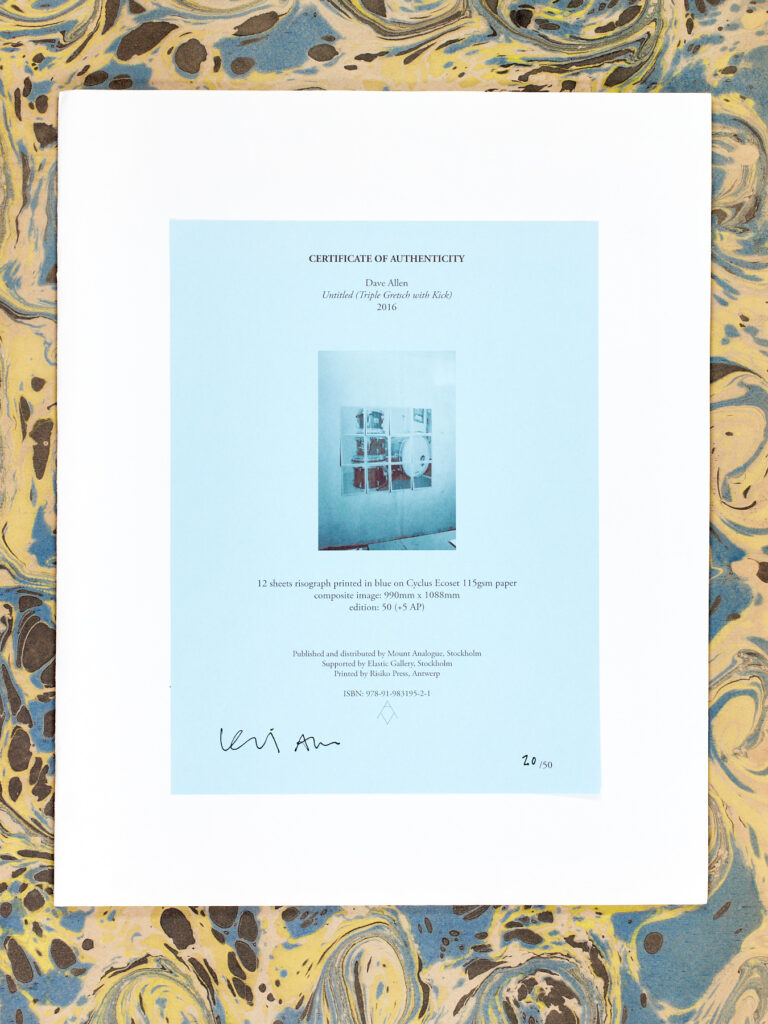
Artist: Dave Allen Title: Untitled (Triple Gretsch with Kick) Description: 12 sheets risograph printed in blue on Cyclus Ecoset 115 gsm paper Composite image, 990 mm x 1088 mm Edition: 50 (+5 AP) Printing: Risiko Press, Antwerp Publisher: Mount Analogue ISBN 978-91-983195-2-1 Price: 850 SEK 2016
Boxed In, Eight Corners by Pol Matthé
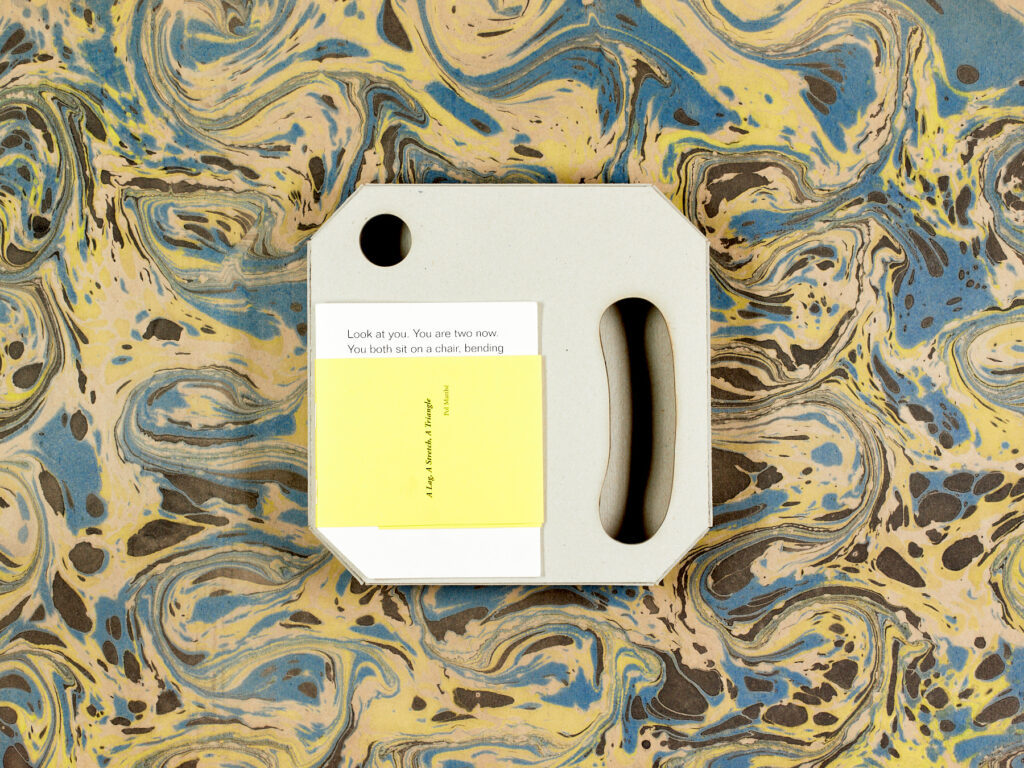
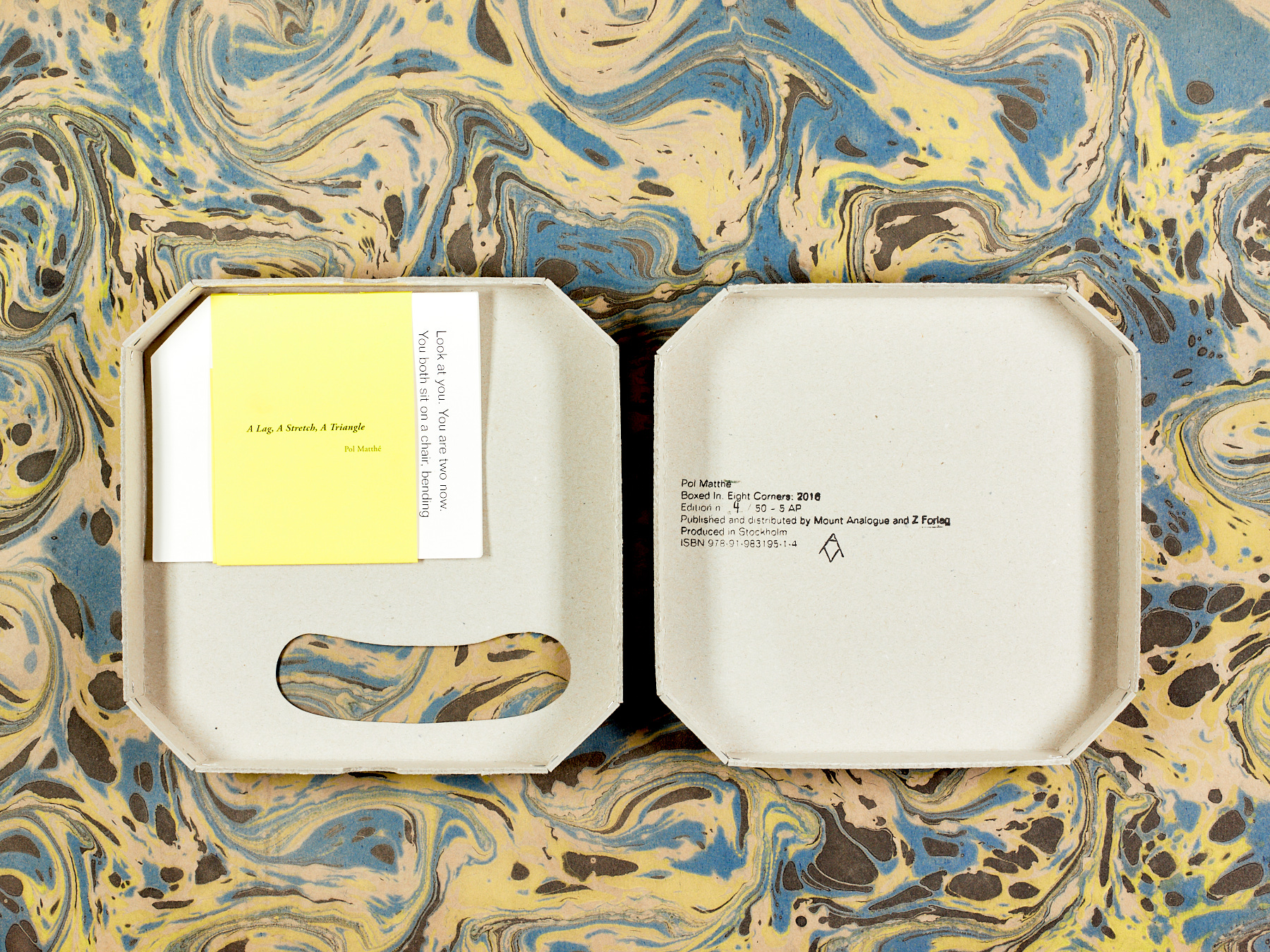
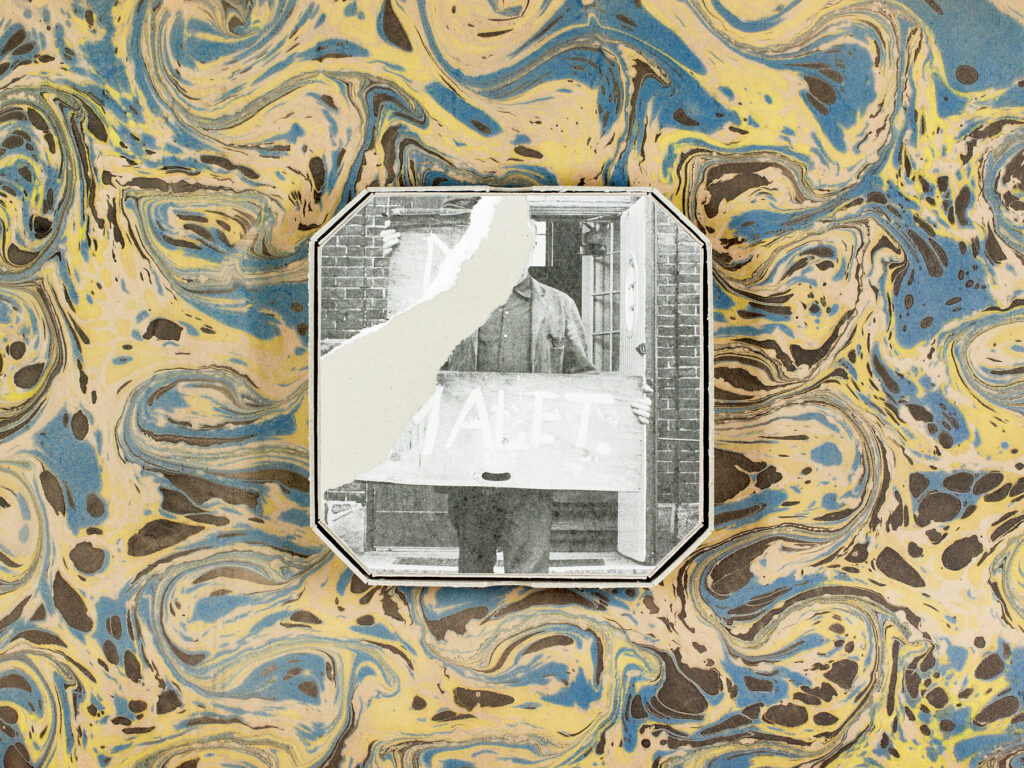
Pol Matthé’s multiple Boxed In, Eight Corners is related to his installation A Lag, A Stretch, A Triangle. The installation consists of two Liesegang overhead projectors connected by a plank of wood. An odd number of balls can be rolled from one octagonal frame to the other, and are projected on the ceiling of the exhibition space.
The multiple relates to elements of the actual installation. An octagonal shape, two parts becoming one piece, a ball and handle cut-out, an inside out. The ripped image shows the Danish artist Asger Jorn in front of the Silkeborg Museum holding a scrap wooden panel with the word ’malet’ painted in white, which in Danish means ’painted’. The panel includes a handle which is cut out. The image is ripped in two, shifted in order to fit the cut-outs of the lid, and glued to the bottom of box, generating an unknown ’in between’. In response to the works Sis Matthé has written a text, which is available here.
Photo by Henrik Follesø Egeland
Pol Matthé is a Belgian artist based in Stockholm. He graduated from the Royal Academy of Fine Arts Antwerp in 2005. Matthé collects and works with notes, found objects, sketches and photographs. By meticulously layering these archives and their encounters, he constructs situation-specific works.
Artist: Pol Matthé Title: Boxed In, Eight Corners Description: Octagonal grey cardboard box with lasercut lid, glued and ripped b&w digital print Printed on Munken Polar 170 gsm, stamped black ink, 187 x 187 x 27 mm Edition of 50 (+5 AP) Produced in Stockholm by Mount Analogue in collaboration with Z Forlag ISBN 978-91-983195-1-4 Sold out 2016
Collapsing Ourselves by Mattin and Hong-Kai Wang
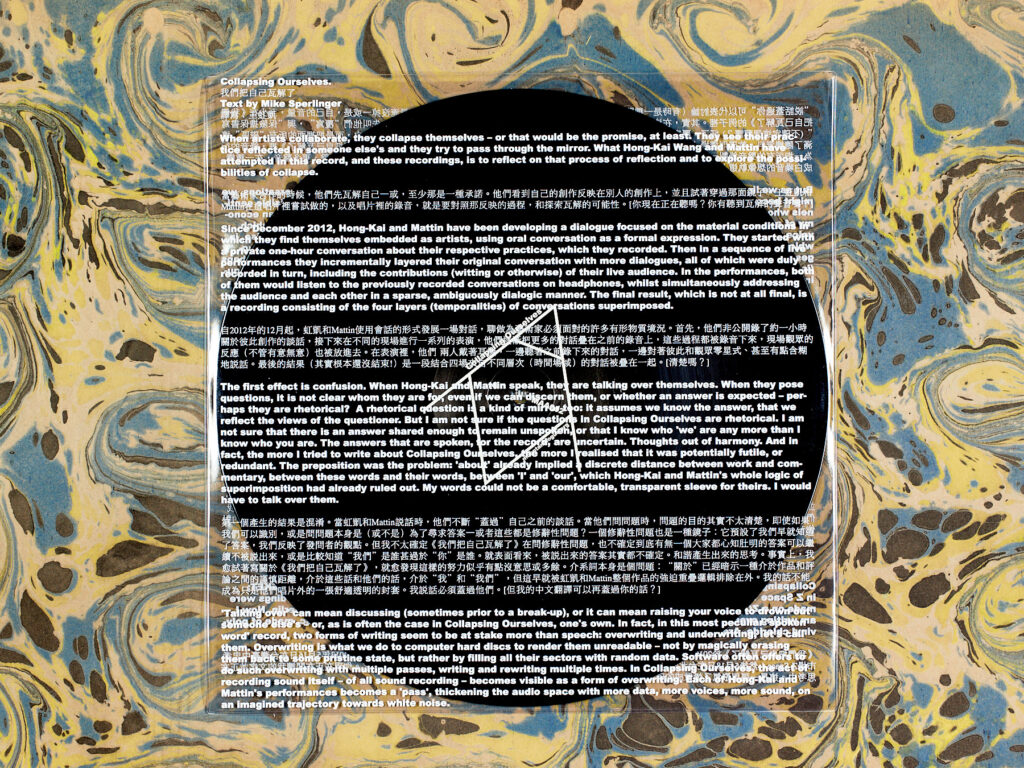
When artists collaborate, they collapse themselves – or that would be the promise, at least. They see their practice reflected in someone else’s and they try to pass through the mirror. What Hong-Kai Wang and Mattin have attempted in this record, and these recordings, is to reflect on that process of reflection and to explore the possibilities of collapse.
Photo by Henrik Follesø Egeland
Since December 2012, Hong-Kai and Mattin have been developing a dialogue focused on the material conditions in which they find themselves embedded as artists, using oral conversation as a formal expression. They started with a private one-hour conversation about their respective practices, which they recorded. Then in a sequence of live performances they incrementally layered their original conversation with more dialogues, all of which were duly recorded in turn, including the contributions (witting or otherwise) of their live audience. In the performances, both of them would listen to the previously recorded conversations on headphones, whilst simultaneously addressing the audience and each other in a sparse, ambiguously dialogic manner. The final result, which is not at all final, is a recording consisting of the four layers (temporalities) of conversations superimposed. – Above excerpt from liner text by Mike Sperlinger
Born in Huwei, Taiwan, Hong-Kai Wang works and lives between Vienna and Taipei. She is currently a PhD in Practice candidate and part of the Spaces of Commoning research team at the Academy of Fine Arts in Vienna. Her works are concerned with the questions of geo-politics and invisible social organization within listening and construction of cultural memory, focused on a collaborative and process-driven approach to research and production. Wang has presented her works at Liquid Architecture (Melbourne/Sydney, 2014), Kunsthall Trondheim (Trondheim, Norway, 2013), Para Site (Hong Kong, 2013), Museum of Modern Art (New York, 2013), among others. Her work spans performance, workshop, text, video and installation.
Artists: Hong-Kai Wang and Mattin Title: Collapsing Ourselves Collapsing Ourselves was written in Stockholm, on 28 March 2013 at EMS; and 30 March at KONSTAPOTEKET; in Z Space Taichung on 16 May 2013; and then at Noise Kitchen in Taipei on 18 May 2013. All the recordings were made on a ZOOM H4. Publishers: Mount Analogue and Audio Visual Arts (AVA), Sold out 2014
Travelling Light by Elisabeth Kihlström and Yuki Higashino
Photo by Henrik Follesø Egeland
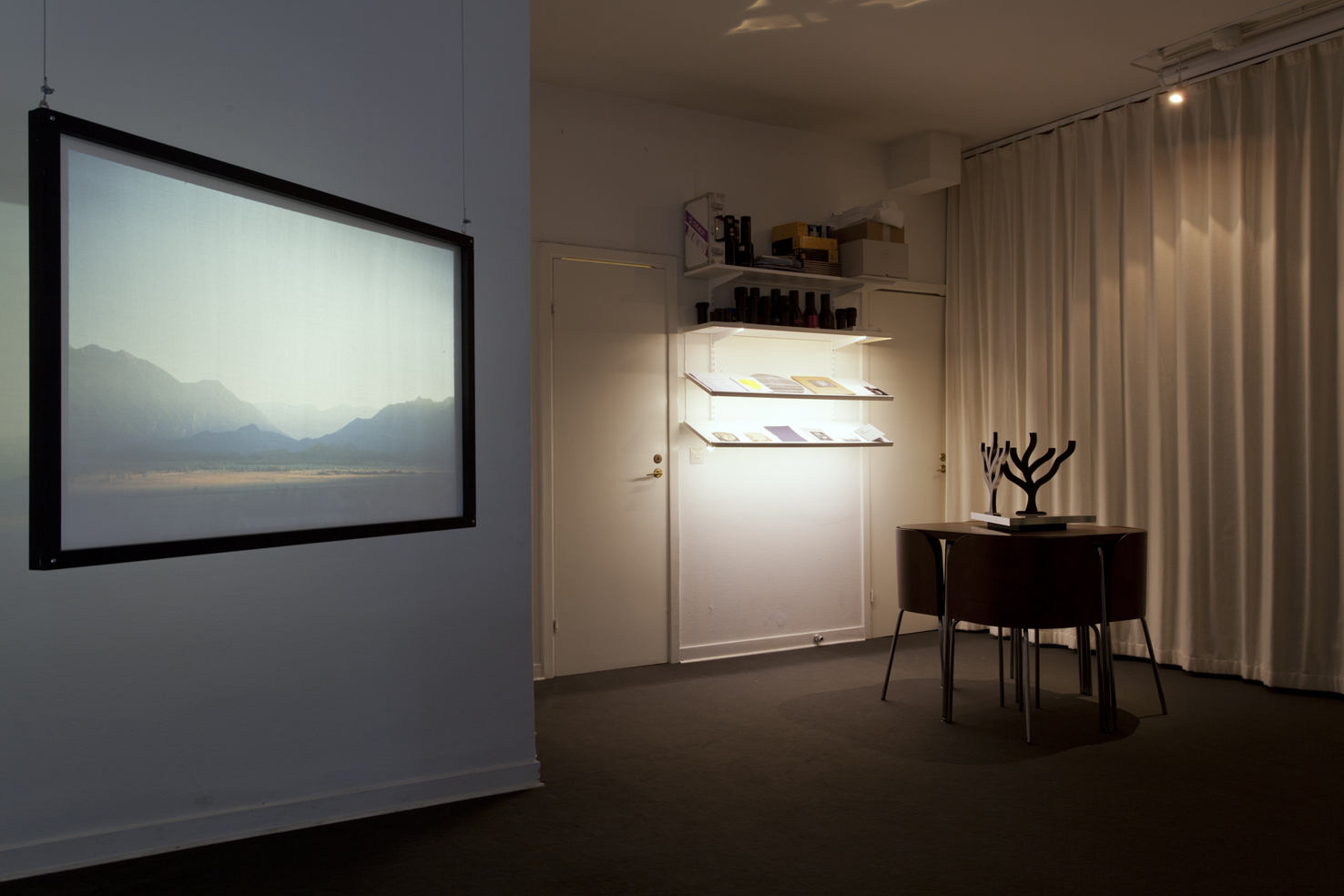
Works featured above: A Celebration of Love and Life (Sunset), 2013, slide projection, silk and wood screen, Electro-Faustus EF102 Photo Theremin and The Host, 2014, stainless steel and wood table sculpture (the wood element designed by Leif Kihlström).
Artists move around. In the past, they went to beautiful places, usually in the south, to be inspired, joined artists’ colonies or ran away from creditors. Today, we do residencies, teach in foreign cities, get funding to go on research trips or fly in to oversee installations. We‘ve been making works about the history of artists’ movements, while thinking about our own travels for the production and presentation of works in this show.
The publication Travelling Light sums up two years of joint work and journey by the artists Elisabeth Kihlström and Yuki Higashino. It was produced during their collaborative exhibition Port at Mount Analogue and will be presented on 11 December 2014, to mark the closing of the exhibition.
Elisabeth Kihlström and Yuki Higashino are artists based in Vienna. They have collaborated on two person shows Daybreak at Platform sarai, Frankfurt (2013) and Territories at Skånes konstförening, Malmö (2014) as well as curatorial project To take a landscape from at Neue Galerie, Innsbruck (2014). They have also been recording and holding concerts as Every Sunday since 2012.
Artists: Elisabeth Kihlström and Yuki Higashino Title: Travelling Light Produced by Mount Analogue and Post Chimney Hand-bound book with silkscreen, stamp, C-print and laser print Edition of 50 Price: 550 SEK 2014
Capitol Complex / Ulterior Vistas by Tris Vonna-Michell
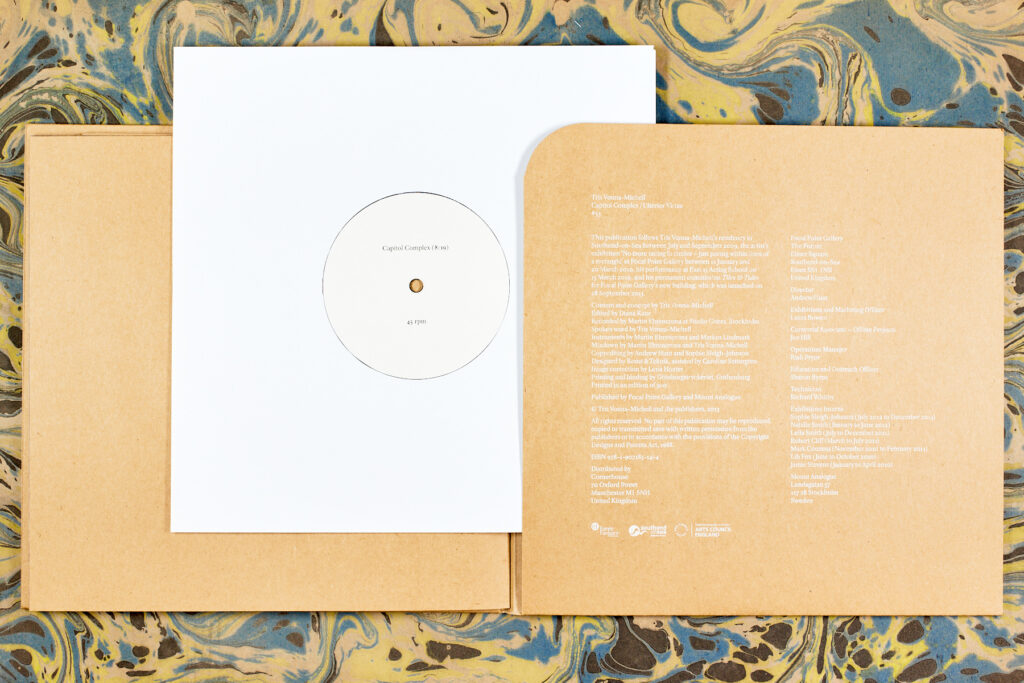
Tris Vonna-Michell´s latest publication is constructed around the two works, Capitol Complex (2012-2014) and Ulterior Vistas (2012-2013), both of which are encapsulated on a ten-inch vinyl record. The spoken-word compositions are enclosed within a gatefold design and accompanied by the Capitol Complex manuscript as a booklet insert and a bound series of Ulterior Vistas photographic montages.
The Capitol Complex (Side A) recording pans between improvised spoken word and musical composition, evolving around a manuscript set in the Indian city of Chandigarh, which serves as an underlining blueprint for the work. Traveller, the protagonist, extends his leisurely strolls to navigating the city by night in order to induce an experience of greater intensity and anxiety of its urban architecture. After his nocturnal explorations in the city’s single-zone sectors he starts to grow weary and changes his course from architectural appreciation to searching for crevices and enclosures to reflect and observe. But urban fixtures of obstruction, surveillance and derailment direct his passages, until a shift in perception occurs.
The spoken word aspect of Ulterior Vistas (Side B) is backed by a musical score, and contextualised around the notion of a driven sales agent, orating a prospectus based on grand 18th Century English landscape garden design. The protagonist is soliciting a global perspective characterised by appropriation of cultural heritage in order to cultivate a desirable public persona for an unidentified client. Aside from offering an array of landscape gardening solutions and attributes he also proposes more abstract features such as synthetic spirituality and symbolic gestures of generosity. The conceptual framework for the Ulterior Vistas photographic series derives from the English landscape architect Humphrey Repton´s (1752-1818) famous Red Books. His books were bespoke landscape and architecture propositions for improving the estates and pleasure grounds of potential clients. The before-and-after illustrations were a key feature in Repton´s Red Books as were his verbal presentations.
Photo by Henrik Follesø Egeland
Artist: Tris Vonna-Michell Title: Capitol Complex / Ulterior Vistas Editor: Diana Kaur Recording: Martin Ehrencrona at Studio Cobra, Stockholm Instruments: Martin Ehrencrona and Markus Lindmark Mixdown: Martin Ehrencrona and Tris Vonna-Michell Copy editing: Andrew Hunt and Sophie Sleigh-Johnson Graphic design: Konst & Teknik, assisted by Caroline Settergren Image correction: Lena Hoxter Printing and binding: Göteborgstryckeriet, Sweden Publishers: Focal Point Gallery and Mount Analogue ISBN 978-1-907185-14-4 Price: 400 SEK 2013
Band 2: Sunday by Robin Watkins
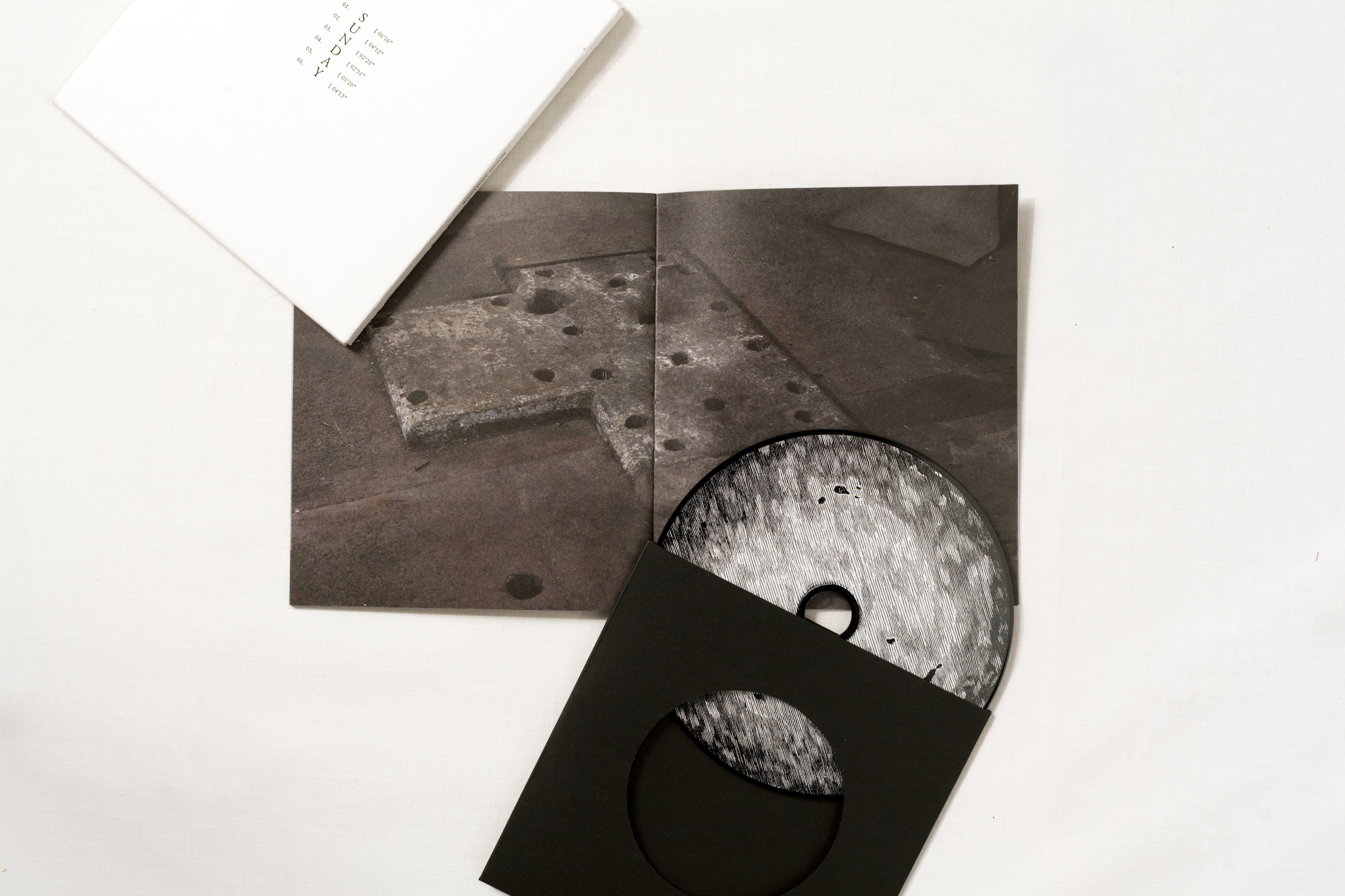
A new edition by Robin Watkins, consisting of a hand-numbered letterpress cover, a compact disc and a 32-page booklet, published by Mount Analogue. The edition documents naturally occurring low frequency electromagnetic fields alongside man-made currents. The recordings were made in and around the derelict Cockatoo Island power plant, during night and dawn of 29 January 2012.
Seven slides Seven takes Seven windows Seven dawns
The recordings were originally made for a site- specific installation in the powerplant on Cockatoo Island, Sydney Harbour (Australia), as part of the 18th Biennale of Sydney. Thanks to Nina Canell, Diana Kaur, Tris Vonna-Michell, Travis Rice and Catherine de Zegher.
Artist: Robin Watkins Mastering: Martin Ehrencrona All photographs taken on site by Robin Watkins Printed parts and layout by Robin Watkins Publisher: Mount Analogue, Stockholm ISBN 978-91-633-8522-3 Sold out 2012
Tris Vonna-Michell by Tris Vonna-Michell
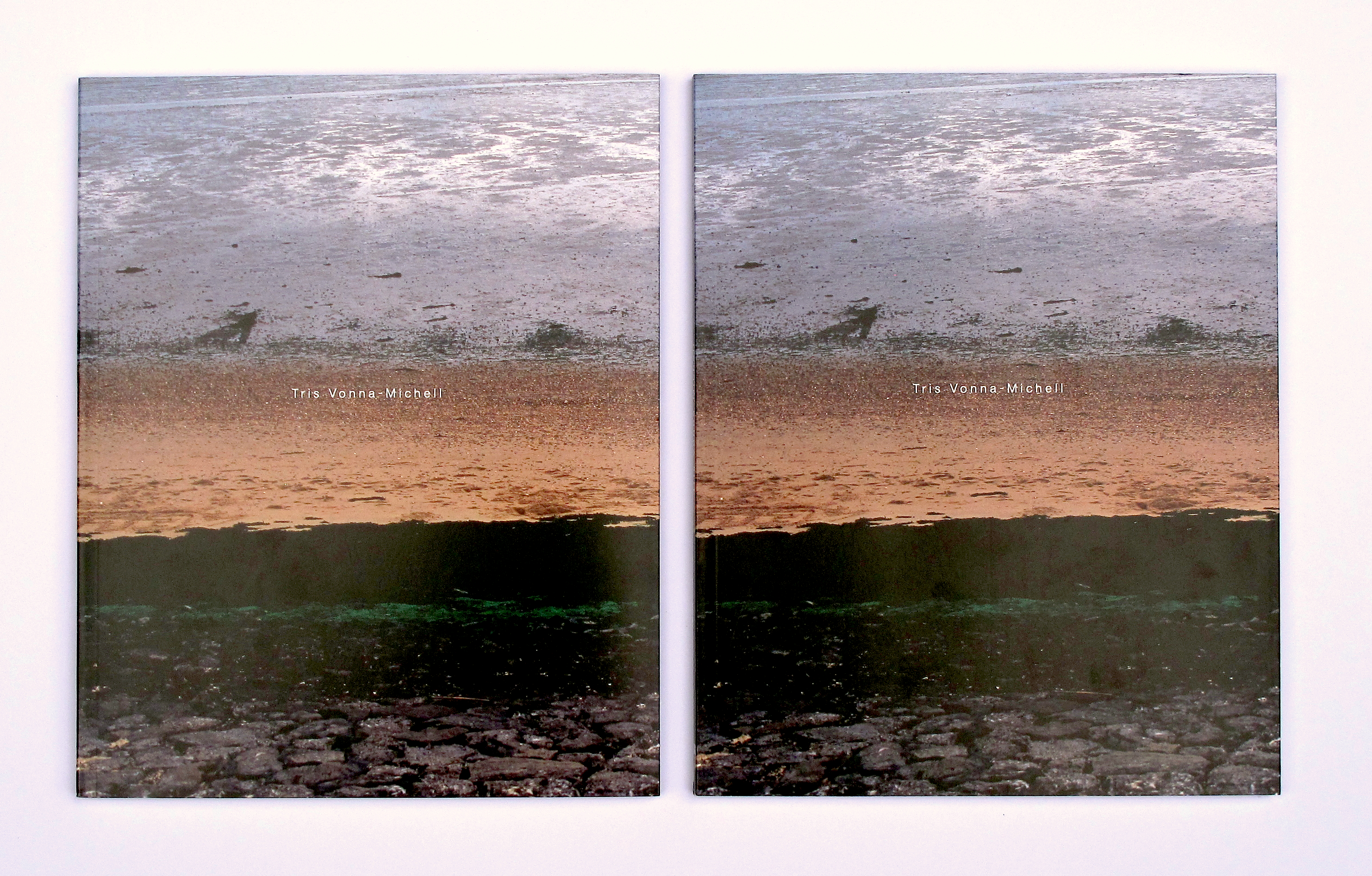
Mount Analogue presents a recently completed book project (2009-2012) by Tris Vonna-Michell in which the stories and the visual material marks a continuation and implementation of his artistic practice through the medium of an artist’s book. Behind an identical cover, the seemingly same is presented in two variations that were developed through performative improvisations over earlier text versions, and repositioning of images and inserts.
The two variations were pendently constructed; book I began in November 2009 at Halle für Kunst in Lüneburg, in which several chapters, texts and images were printed on a Heidelberg GTO printing press on a daily basis during the exhibition ”Capstans”. In 2010 book II began as a revisitation and expansion of the first variation, in which the previous narratives, images and inserts were reconstructed.
Text and images by Tris Vonna-Michell Graphic design by Manuel Raeder with Tris Vonna-Michell Published by JRP|Ringier, together with with Fondazione Galleria Civica—Centro di Ricerca sulla Contemporaneità di Trento, GAMeC—Galleria d’Arte Moderna e Contemporanea di Bergamo, Halle für Kunst Lüneburg e.V., and Kunsthalle Zürich, 2011 Printed in Germany ISBN 978-3-03764-170-5 Price: 400 SEK each (or both: 650 SEK)
ak28 revisited and three parallell visions edited by Diana Kaur
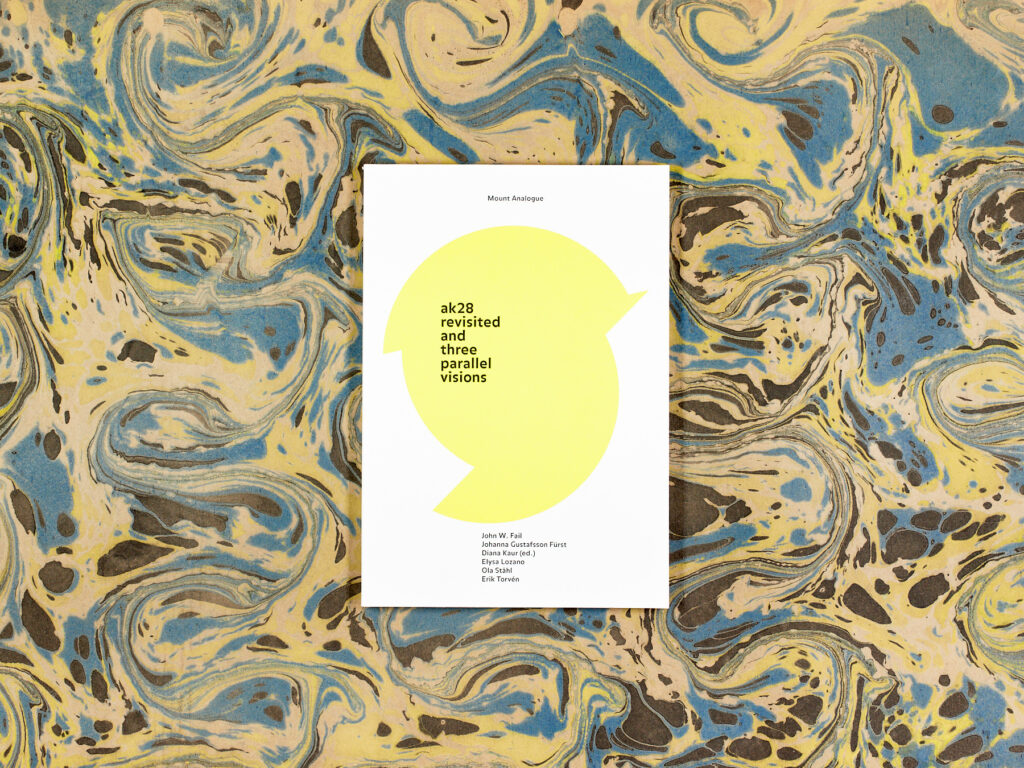
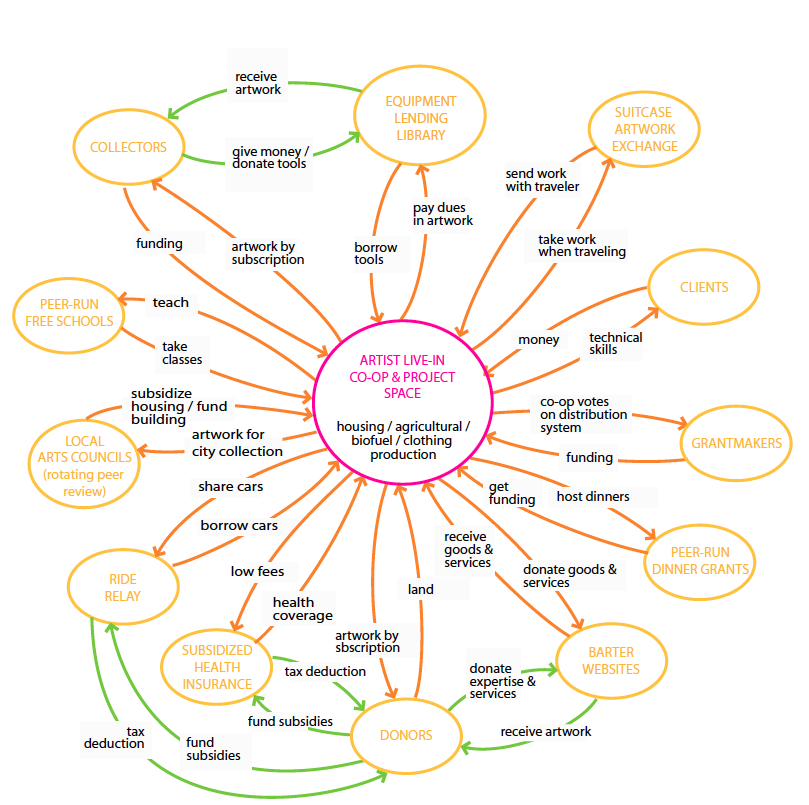
ak28 was a self-organised, primarily self-funded, collective of artists, architects and curators, which ran a space for exhibiting artistic practices in Stockholm between 2003 – 2009. This book combines the legacy of ak28 with the presentation of three individual artistic stances derived from varying collaborative experiences. These initiatives operate in the same non-profit sphere as ak28, but on different, or rather parallel premises. These are Elysa Lozano for Autonomous Organization, based in New York, John W. Fail from Ptarmigan Helsinki/Tallin and Ola Ståhl, from what was a loosely London-based artist collective, C.CRED.
Image by Henrik Follesø Egeland
Diagram for the New Art World Economy By Elysa Lozano for Autonomous Organization, 2010 Printed on the occasion of the release of ak28 and three parallel visions
Editor: Diana Kaur Texts: John W. Fail, Johanna Gustafsson Fürst, Elysa Lozano, Ola Ståhl and Erik Torvén and Diana Kaur Graphic design: Christopher West Publisher: Mount Analogue Printing: Exaktaprinting Malmö AB, Malmö, Sweden ISBN 978–91–633–8523–0 Price: 100 SEK 2011
;)
;)
;)
;)
;)